Pip: Thestealingofemily.co.uk — a site that exists because a child was taken, a case was closed without resolution, and someone decided that silence is not the same as an answer.
Mara: Martin Newbold is the author behind everything here, and today we’re looking at a formal letter that puts a direct legal question to East Sussex County Council — nineteen years on. Let’s start with the letter itself, and what an adverse inference actually demands.
When Silence Becomes an Answer: The 19-Year Safeguarding Gap
Pip: The core tension here is a legal and moral one — not whether documents are missing, but what their absence means. A safeguarding review was conducted in 2009 by an Independent Reviewing Officer named Fiona Lewis. Nearly two decades later, there is still no demonstrated resolution, and this letter is asking East Sussex County Council to explain that gap directly.
Mara: The letter sets the stakes plainly. The quote at its centre reads: “You carried statutory responsibility for this matter. You held the records. You possessed the safeguarding mechanisms. Nineteen years later you still cannot demonstrate a proper resolution. If the evidence that should prove that resolution cannot be produced, I invite the inference that the missing evidence would not support East Sussex County Council’s position.”
Pip: So the upshot is this — the adverse inference principle isn’t an accusation, it’s a structured invitation. Produce the records, explain what was done, and the inference evaporates. Stay silent, and the silence speaks.
Mara: That distinction matters. The letter is explicit that an adverse inference is not proof. It asks four specific questions: why the situation drifted unresolved, what the council’s own record shows Fiona Lewis did in her independent reviewing capacity, at what point the council asserts the concern was actually resolved, and where the records demonstrating that resolution are.
Pip: And the letter is careful to head off a particular kind of deflection — the idea that the burden falls on the person asking to identify which specific document is missing. The letter says that is not sufficient. The duty to create, maintain, and produce those records was the council’s from the outset.
Mara: That framing connects directly to the companion pieces from the day before — the submission regarding outstanding matters, adverse inferences, and compliance with Section 71 of the IBAC Act, and its accompanying podcast episode. Those pieces lay out the same adverse inference framework in the context of a separate integrity process, establishing that this is a consistent legal argument being applied across multiple institutions, not a one-off complaint.
Pip: The question isn’t which document went missing. It’s whether the safeguarding system did its job at all — and who answers for it when no one can show that it did.
Mara: And that question is still formally open, waiting on a response from East Sussex Safeguarding.
Pip: Nineteen years is a long time for a statutory duty to go undemonstrated. The adverse inference framework turns that silence into a question that has to be answered.
Mara: The same argument is running across multiple processes simultaneously. That’s where the next episode picks up.
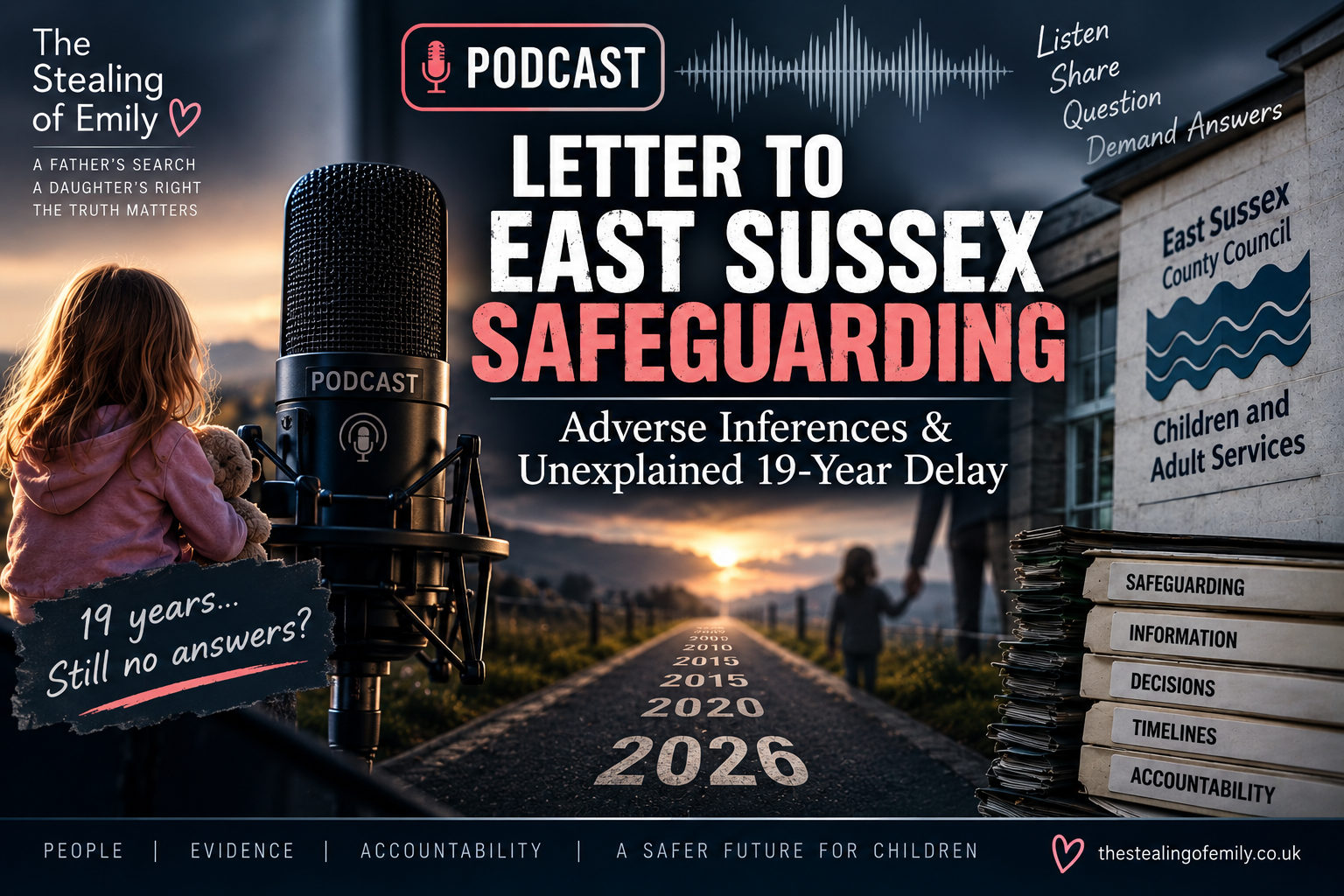
- Podcast Episode: Letter to East Sussex Safeguarding — Adverse Inferences & Unexplained 19‑Years
- Letter to East Sussex Safeguarding — Adverse Inferences & Unexplained 19‑Year Delay
- Podcast Episode: Submission Regarding Outstanding Matters, Adverse inferences, and Compliance wit
- Submission Regarding Outstanding Matters, Adverse inferences, and Compliance with Section 71 of The IBAC Act
- Podcast Episode: Victoria Integrity Complaint Standoff





Leave a Reply