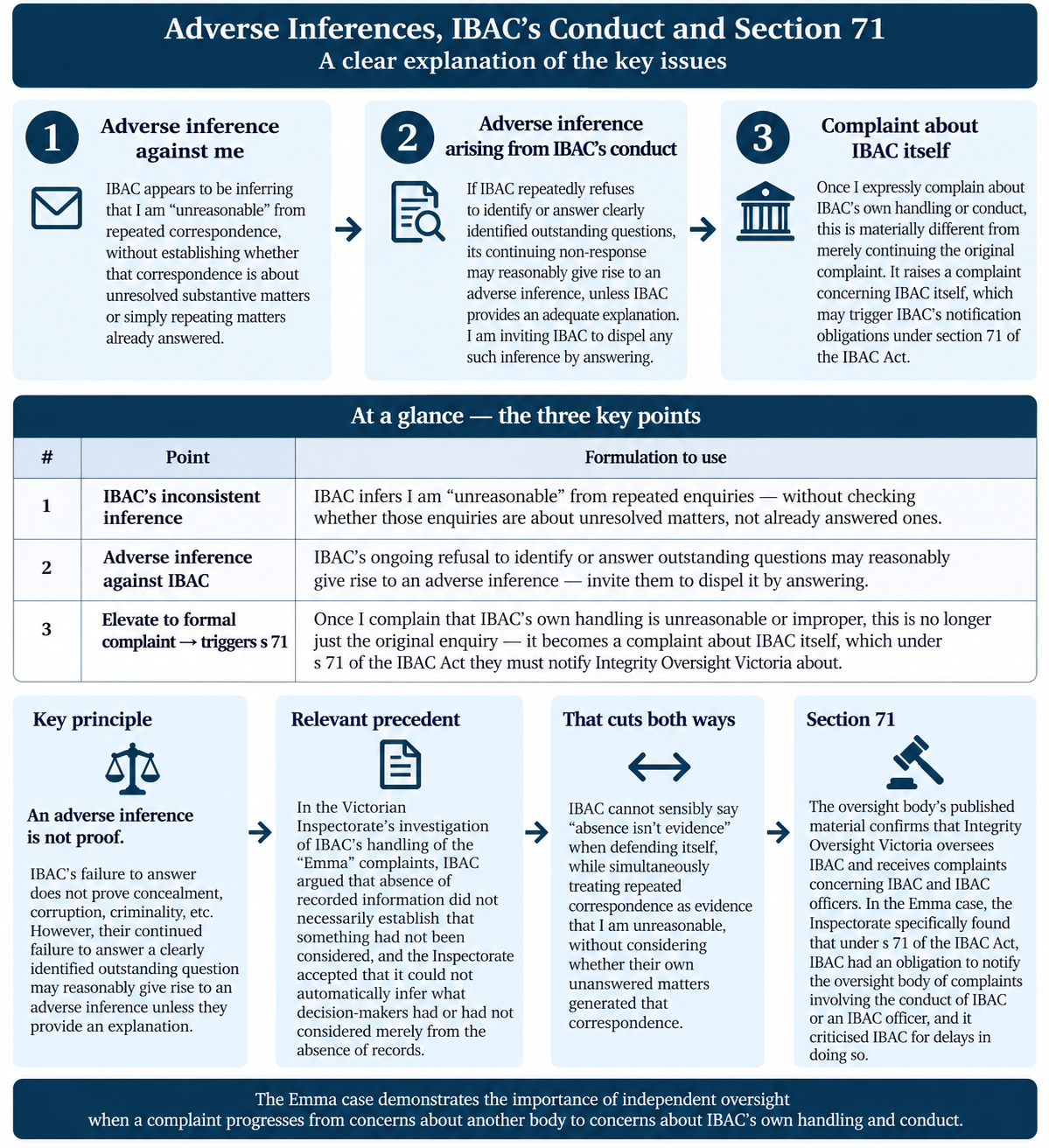
There is an important distinction, though. An adverse inference is not proof. Equally, you should not say that IBAC’s failure to answer proves concealment, corruption, criminality, etc. A stronger formulation is that their continued failure to answer a clearly identified outstanding question may reasonably give rise to an adverse inference unless they provide an explanation.
There is actually an unusually relevant precedent involving IBAC itself. In the Victorian Inspectorate’s investigation of IBAC’s handling of the “Emma” complaints, there was a dispute about whether conclusions could be drawn from information being absent from IBAC’s files. IBAC argued that absence of recorded information did not necessarily establish that something had not been considered, and the Inspectorate accepted that it could not automatically infer what decision-makers had or had not considered merely from the absence of records.
That cuts both ways. IBAC cannot sensibly say “absence isn’t evidence” when defending itself while simultaneously treating repeated correspondence as evidence that you are unreasonable without considering whether their own unanswered matters generated that correspondence.
There is another potentially more important issue in this case. The oversight body’s published material confirms that Integrity Oversight Victoria oversees IBAC and receives complaints concerning IBAC and IBAC officers. And in the Emma case, the Inspectorate specifically found that under s 71 of the IBAC Act, IBAC had an obligation to notify the oversight body of complaints involving the conduct of IBAC or an IBAC officer; it criticised IBAC for delays in doing so.
1. Adverse inference against this:
IBAC appears to be inferring unreasonableness from repeated correspondence without establishing whether that correspondence consists of repetitions of answered matters or continuing attempts to obtain answers to unresolved substantive matters.
2. Adverse inference arising from IBAC’s conduct:
If IBAC repeatedly refuses to identify or answer the outstanding information request, you can say that its continuing non-response is capable of giving rise to an adverse inference, while making clear you are inviting IBAC to dispel that inference by answering.
3. Complaint about IBAC itself:
Once you expressly complain that IBAC’s own handling is unreasonable or improper, that is materially different from merely continuing the original complaint. The s 71 notification issue may therefore become relevant.
| # | Point | Formulation to Use |
|---|---|---|
| 1 | IBAC’s inconsistent inference | IBAC infers I am “unreasonable” from repeated enquiries — without checking whether those enquiries are about unresolved matters, not already answered ones. |
| 2 | Adverse inference against IBAC | IBAC’s ongoing refusal to identify/answer outstanding questions may reasonably give rise to an adverse inference — invite them to dispel it by answering. |
| 3 | Elevate to formal complaint → triggers s.71 | Once you complain that IBAC’s own handling is unreasonable/improper, this is no longer just your original enquiry — it becomes a complaint about IBAC itself, which under s.71 IBAC Act they must notify IOV about. |
SECTION 71 — COMPLAINTS ABOUT IBAC’S OWN CONDUCT.
There is a further and particularly important issue.
In October 2022, the Victorian Inspectorate (now Integrity Oversight Victoria) published a Special Report examining IBAC’s handling of complaints made by a woman known publicly as “Emma” (later identified as Dr Jana Katerinskaja).
Emma was a victim of family violence perpetrated by a serving Victoria Police officer. She alleged that:
- Police mishandled her complaints;
- Her confidential escape plan was leaked to her abuser;
- IBAC then referred her complaints back to Victoria Police for investigation — effectively having police investigate their own colleagues;
- IBAC failed to properly monitor what happened next, with serious consequences for her safety.
The Inspectorate found IBAC’s handling was seriously deficient, delayed, and failed to address the systemic conflict-of-interest issues Emma had raised. IBAC later issued a public apology (March–May 2026).
It is important to note that an adverse inference is not proof. Equally, IBAC should not treat my repeated correspondence as evidence of unreasonableness, without first acknowledging that this correspondence arises directly from unanswered substantive questions. “IBAC has previously argued” — in the Emma complaints matter — that absence of information does not automatically prove a conclusion. That principle applies equally here: IBAC’s continued failure to answer clearly identified outstanding questions may reasonably give rise to an adverse inference, unless IBAC provides a full explanation. Further, insofar as this matter now concerns IBAC’s own handling and conduct, this engages s 71 of the IBAC Act and triggers an obligation to notify Integrity Oversight Victoria — which oversees IBAC and receives complaints concerning its conduct — and IBAC should therefore comply with that requirement without delay.
The position can be understood as involving three separate but connected issues. These are set out first in summary form so that the reasoning is clear, before each issue is addressed in greater detail below.
The first concerns the inference IBAC appears to be drawing from the volume or repetition of my correspondence. The second concerns the inference that may legitimately arise from IBAC’s own continuing failure to answer identified outstanding matters. The third is legally distinct: once my correspondence expressly complains about IBAC’s own handling or conduct, the question of IBAC’s notification obligations under section 71 of the IBAC Act arises.
These issues should not be conflated. An adverse inference is an evidential or reasoning issue; section 71 concerns a separate statutory oversight obligation.
DETAILED APPLICATION – 1. ADVERSE INFERENCE AGAINST ME
IBAC appears to be treating repeated correspondence as potentially unreasonable or excessive.
Before drawing such a conclusion, IBAC should distinguish between correspondence which merely repeats matters already substantively answered and correspondence which continues because questions, information requests, complaints or other substantive matters remain unresolved.
Where repeated correspondence has been generated by a continuing failure to answer an identified substantive matter, the volume of correspondence cannot fairly be considered in isolation from the circumstances which caused it.
DETAILED APPLICATION – 2. ADVERSE INFERENCE ARISING FROM IBAC’S OWN CONDUCT
Conversely, where IBAC has repeatedly been asked to identify or answer a clearly stated outstanding matter and continues not to do so, that conduct may reasonably give rise to an adverse inference unless IBAC provides an adequate explanation.
I expressly do not present such an inference as proof.
I am giving IBAC the opportunity to dispel any such inference by identifying the outstanding matters, answering them substantively, or providing a proper explanation as to why they will not be answered.
DETAILED APPLICATION – 3. COMPLAINT CONCERNING IBAC’S OWN HANDLING
My correspondence now expressly concerns not merely the original matters placed before IBAC but also IBAC’s own subsequent conduct and handling of those matters.
That includes its treatment of continuing correspondence as potentially excessive or unreasonable while substantive matters remain outstanding.
This is therefore materially different from simply repeating the original complaint. It raises a complaint concerning IBAC’s own handling and conduct.
STATUTORY CONSEQUENCE – SECTION 71 — COMPLAINTS ABOUT IBAC’S OWN CONDUCT
In October 2022, the Victorian Inspectorate, now Integrity Oversight Victoria, published its Special Report concerning IBAC’s referral and oversight of complaints made by the person then publicly referred to as “Emma”, who has since publicly identified themself as Dr Jana Katerinskaja.
Dr Katerinskaja had experienced family violence perpetrated by their then-partner, a serving Victoria Police officer.
The matter raised serious concerns regarding Victoria Police’s handling of the complaints, disclosure of confidential information concerning Dr Katerinskaja’s safety and plans to leave the relationship, conflicts of interest arising from police involvement in investigating complaints concerning fellow officers, IBAC’s decision to refer matters back to Victoria Police, and IBAC’s subsequent oversight of those investigations.
The Victorian Inspectorate identified serious and longstanding deficiencies in the response. Its report found, amongst other matters, that IBAC’s referral and oversight left systemic issues largely unexamined for an extended period and contributed to circumstances involving serious conflicts of interest.
IBAC subsequently apologised publicly for aspects of its handling of Dr Katerinskaja’s complaints.
Of particular relevance here, the Inspectorate addressed IBAC’s obligations under section 71 of the Independent Broad-based Anti-corruption Commission Act 2011.
The Inspectorate stated that, under section 71, IBAC has an obligation to notify its oversight body of any complaint or notification to IBAC involving the conduct of IBAC or an IBAC officer.
In the Emma matter, the Inspectorate found that correspondence complaining directly about IBAC’s handling clearly came within the scope of section 71 and criticised IBAC for failing to notify the Inspectorate at the appropriate time.
That precedent is directly relevant to the present circumstances.
My correspondence now expressly raises a complaint concerning IBAC’s own conduct and handling of this matter.
Accordingly, insofar as my correspondence constitutes a complaint or notification involving the conduct of IBAC or an IBAC officer within section 71, IBAC is required to comply with its statutory notification obligation to Integrity Oversight Victoria.
I therefore request that IBAC confirm:
- whether it accepts that my correspondence contains a complaint concerning the conduct of IBAC or an IBAC officer;
- whether that complaint has been notified to Integrity Oversight Victoria pursuant to section 71;
- the date upon which that notification was made; and
- if IBAC considers that no notification obligation arises under section 71, the basis upon which it has reached that conclusion.
The Emma matter demonstrates the importance of independent oversight where a complaint progresses from concerns about another body to concerns about IBAC’s own handling and conduct.
IBAC’s characterisation of continuing correspondence as excessive or unreasonable does not itself dispose of the substantive matters raised within that correspondence, nor does it remove any statutory obligation which arises because the correspondence includes a complaint concerning IBAC itself.
cite:




Leave a Reply