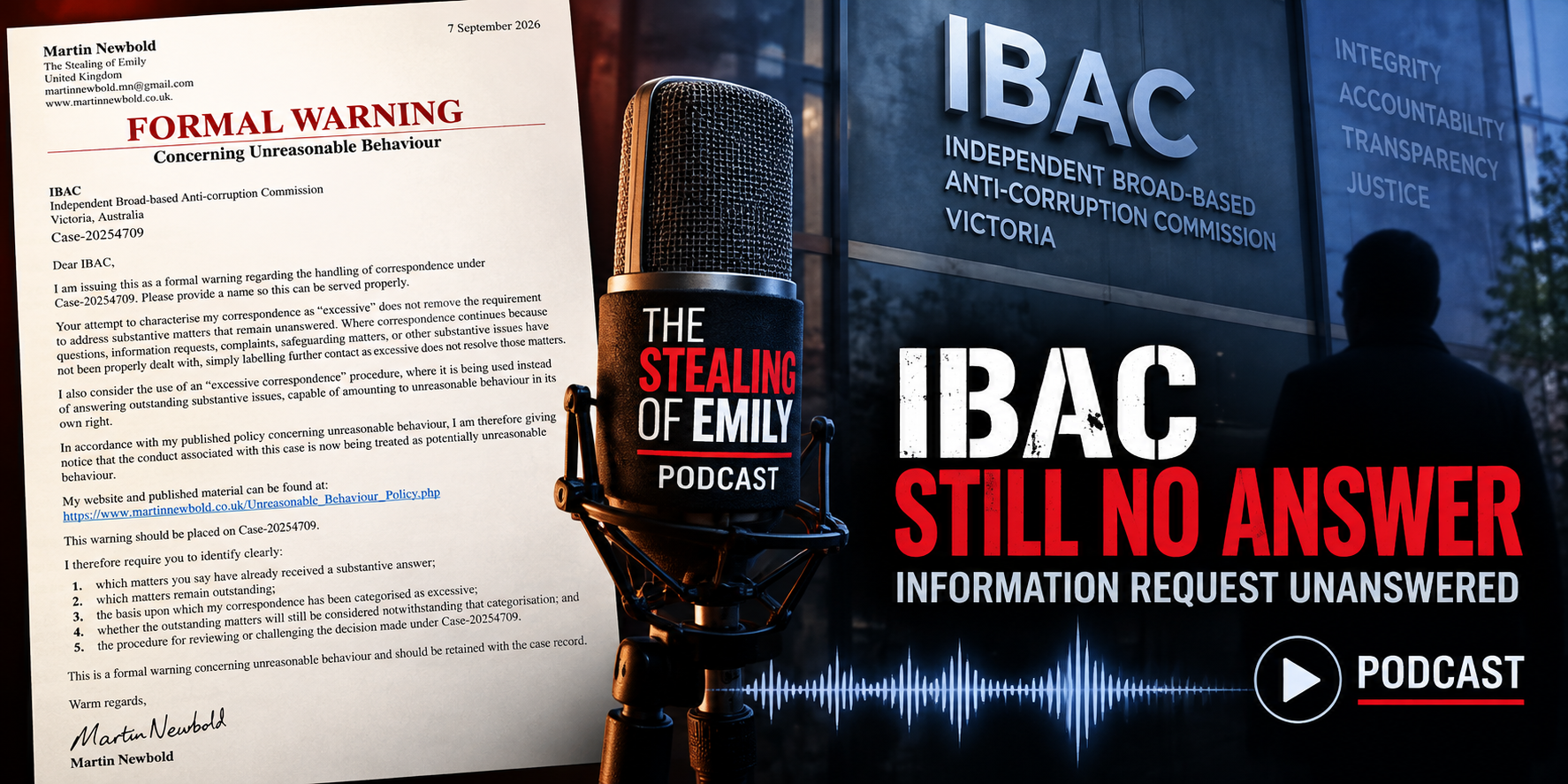
Pip: Welcome to The Stealing of Emily — the site where the paper trail is longer than the response, and the response is usually nothing.
Mara: Martin Newbold has been documenting his attempts to extract information from IBAC, Victoria’s anti-corruption body, and what he’s found is a pattern of delay, redirection, and silence. Today we’re looking at what that looks like in practice.
Pip: Let’s start with the information requests themselves — and what happens when an institution decides that calling something closed is easier than answering it.
IBAC’s Silence on Operation Dunham
Mara: The core tension here is straightforward: an anti-corruption body has been asked for specific records, has not provided them, and is now warning the requester about the volume of his follow-up correspondence.
Pip: The post puts it plainly. The direct challenge to IBAC reads: “That does not answer the information I have repeatedly requested” — and then lists exactly what is missing: the audio recording of Matthew Dunkley at Bunny’s Bar, his full exit details from Victoria and Australia, his ministerial records, and the documented 1997 Blair meeting confirmed under FOI references.
Mara: What that means in practice is that IBAC has not disputed the existence of these records — it has simply declined to produce them while characterising the follow-up as excessive. The post is explicit: “Taking over a year to process this is not reasonable.”
Pip: And the second post, “Patrick Rundle the Department of Education and Honorable Ben Carol MP direct IBAC to reply,” fills in why there are seventeen pieces of correspondence in the first place. The Governor’s Office directed the requester to Ben Carroll’s office. Carroll’s office directed the Department of Education to respond. The Department confirmed the material was associated with Operation Dunham and pointed back to IBAC.
Mara: So the correspondence volume IBAC is citing as a reason to limit contact is a direct consequence of following the routes Victoria’s own institutions prescribed. The post asks the question directly: “how can a public anti-corruption body warn a person about the quantity of his correspondence while failing to provide a substantive answer to the information request that caused that correspondence to continue in the first place?”
Pip: That is a genuinely difficult question to answer without either producing the records or stating a lawful basis for refusing them. Neither has happened.
Mara: The post also notes that GDPR exposure may be in play — that failure to deal with a valid information request isn’t just an administrative shortcoming, it could carry criminal liability. And the underlying request remains the same as it was at the start: where is the Operation Dunham material, and if IBAC won’t release any part of it, what is the recorded legal basis for that refusal?
Pip: An institution that calls a complaint final without answering the question inside it hasn’t closed anything — it’s just stopped reading.
Mara: The documentary trail is there. The question now is whether IBAC will respond to what the trail actually says.
Pip: The through-line here is institutions directing someone through a maze and then citing the length of the maze as a problem.
Mara: The records exist. The requests are specific. The next move belongs to IBAC.




Leave a Reply