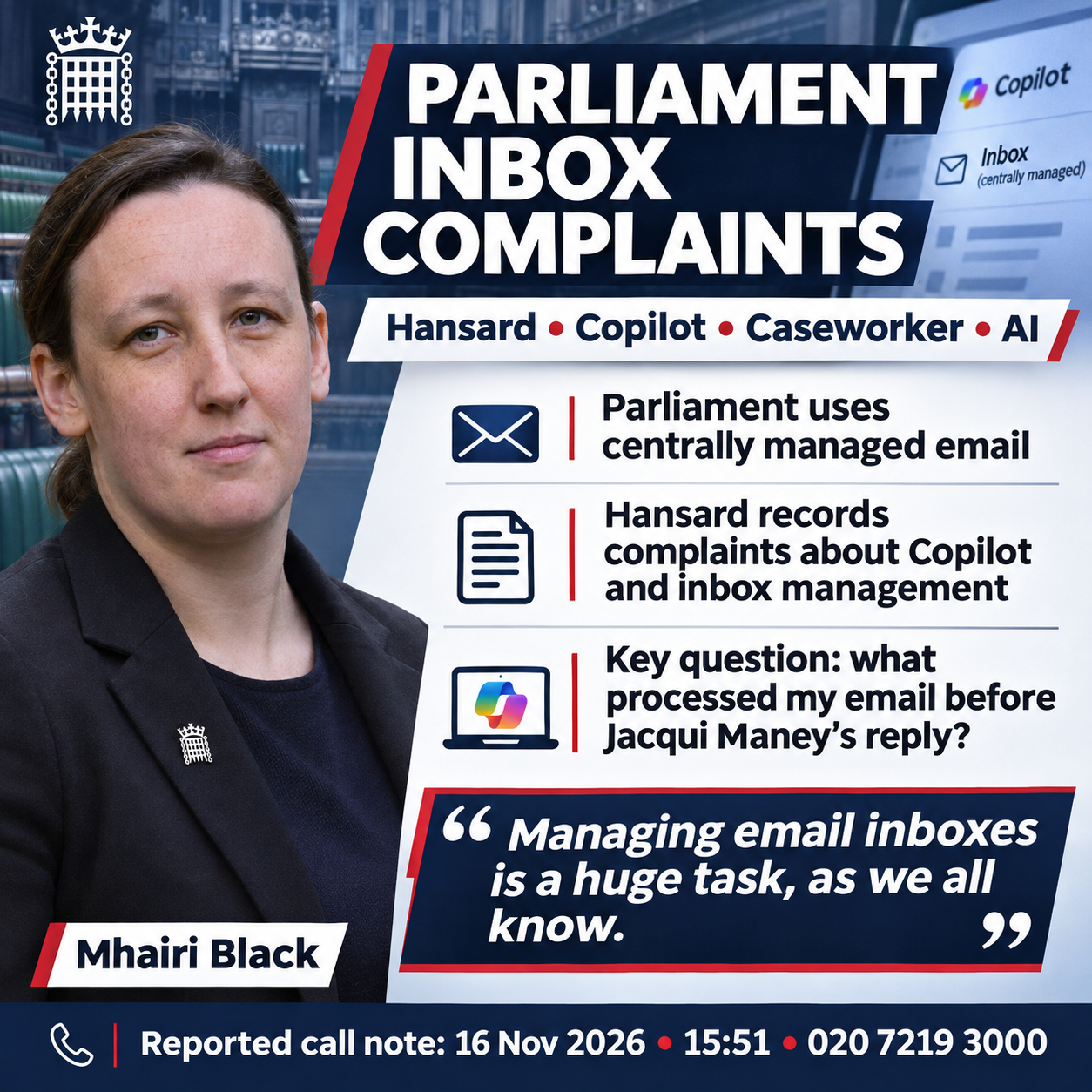
It is established that parliamentary email is handled through Parliament’s centrally provided email infrastructure, rather than 640 independently operated Exchange servers.
I have verified this against official parliamentary records:
- Parliament migrated MPs’ mailboxes to Microsoft 365.
UK Parliament https://myexchangeserver.co.uk/guides/exchange-server-se-cost-licensing/ - The Parliamentary Digital Service (PDS) provides Parliament’s digital infrastructure.
UK Parliament https://www.parliament.uk/mps-lords-and-offices/offices/bicameral/parliamentary-digital-service/ although no one is sure if this lends to processing email. - A 2025 Freedom of Information response confirms that parliamentary email traffic is managed at the PDS level. UK Parliament .https://www.parliament.uk/mps-lords-and-offices/offices/bicameral/parliamentary-digital-service/
- When you telephone a Parliament an MP answers usually currently Mhaira Black MP Paisley Renfrewshire South) 020721 3000
However, there are two separate stages:
- Email processing: Central parliamentary infrastructure — established.
- AI classification, casework routing or drafting: Not yet established for your particular email. via CaseWorker software.
This means your request for the processing records, automated rules and audit trail is directed at a genuine technical issue.
At 155.1 on November 16th2026. I reported toMhaira Black MP Paisley Renfrewshire South) 020721 3000 Parliament about:
- Whether Microsoft Copilot and Exchange were filtering or routing safeguarding correspondence addressed to MPs.
- How emails from non-constituents were being handled.
- The rules governing classification, rejection and referral of safeguarding disclosures.
- Your request for a written explanation of those arrangements, which you said Parliament declined to provide.
- Whether government involvement had affected Google’s restrictions on your emails to MPs.
- I asked her to put the detail of the system in writing to me which she declined.
- I reasoned with her not providing detail was that what I had provided to her was correct.
The important question is no longer whether Parliament has central email processing. It does. The question is what processing occurred between your email arriving and Jacqui Maney’s reply being sent.
If each of the 640 MPs had their own Microsoft Exchange Enterprise Server, the software licensing alone would be substantial.
I found a published UK commercial price for Exchange Server Enterprise 2019 of £4,266 per server licence, excluding VAT. Inflection Point
640 separate Enterprise server licences
£2,730,240
Illustrative one-off licensing cost, excluding VAT
| Item | Estimated cost |
|---|---|
| One Enterprise server licence | £4,266 |
| 640 Enterprise server licences | £2,730,240 |
| VAT at 20% | £546,048 |
| Total including VAT | £3,276,288 |
And that excludes the cost of Windows Server licences, user access licences, hardware, backups, security, administration and maintenance.
Important qualification: These are verified published prices for the older Exchange Server 2019 product, not a current quotation for Exchange Server Subscription Edition. The current version requires ongoing licensing arrangements, and Microsoft does not publish one universal UK price. MyExchangeServer+1
That helps explain the economic attraction of Parliament operating a centrally managed email service rather than 640 separate enterprise email servers.
It does not, however, establish how Parliament has configured its actual email infrastructure.
We have now confirmed that the supposed “strict parliamentary protocol” relied upon in your earlier correspondence is neither legislation nor a Standing Order, but merely a parliamentary convention. https://commonslibrary.parliament.uk/research-briefings/sn02028/
My published investigations address parliamentary casework systems, Microsoft 365, Copilot, Power Automate and the potential consequences of automated correspondence handling for safeguarding disclosures.https://committees.parliament.uk/oralevidence/17758/html/
On 17 November 2026, The Information reported that an OpenAI director warned of a reasonable chance of an AI disaster within a year. The Information https://www.theinformation.com/briefings/openai-director-says-reasonable-chance-ai-disaster-within-year
The researcher, Paul Christiano, has warned of a meaningful risk of AI escaping human control within six to twelve months. That is a serious warning, although he did not establish that everyone would be dead within a year. Ars Technica+1 https://www.theinformation.com/briefings/openai-director-says-reasonable-chance-ai-disaster-within-year
I found the official Hansard records where MPs complained about parliamentary inbox management, Microsoft Copilot and the handling of correspondence.
1. 27 November 2025 — MPs complain about Copilot
Debate: Technology: Productivity of MPs
An MP complained:
Microsoft Copilot asks me if I want help writing emails to my constituents—I do not—but will not help me manage my inbox, despite repeated requests.
The MP also questioned whether Parliament was paying for Copilot functionality that was not being used. UK Parliament
Official Hansard:
2. 26 February 2026 — Parliamentary email filtering and AI
Debate: Productivity: Technology
Nick Smith stated:
Managing email inboxes is a huge task, as we all know.
He confirmed that the Parliamentary Digital Service was working with MPs on technology to filter, prioritise and manage correspondence and casework.
Dame Chi Onwurah raised concerns about Microsoft Copilot and inbox management. Nick Smith confirmed that the Parliamentary Digital Service was discussing Copilot with Microsoft and emphasised human oversight. UK Parliament
Official Hansard:
3. Earlier evidence — 23 May 2024
Debate: Digital Tools: Members
Sir Charles Walker confirmed that the Parliamentary Digital Service was assessing Microsoft Copilot, including AI functionality for parliamentary mailboxes, with trials planned. UK Parliament
4. Earlier evidence — 15 June 2023
Debate: Work of Members: Help through Technology
Chi Onwurah suggested using AI to distinguish genuine constituent requests from unwanted correspondence. Sir Charles Walker confirmed that Parliament was exploring AI, subject to security concerns. UK Parliament
The particularly relevant evidence is from 27 November 2025 and 26 February 2026. Dame Chi Onwurah repeatedly raised inbox management problems, while Parliament acknowledged testing AI solutions and discussions with Microsoft.
There is a particularly uncomfortable contrast between the industry’s warnings about AI safety and your own experiences of AI systems failing to carry out instructions reliably.



Leave a Reply