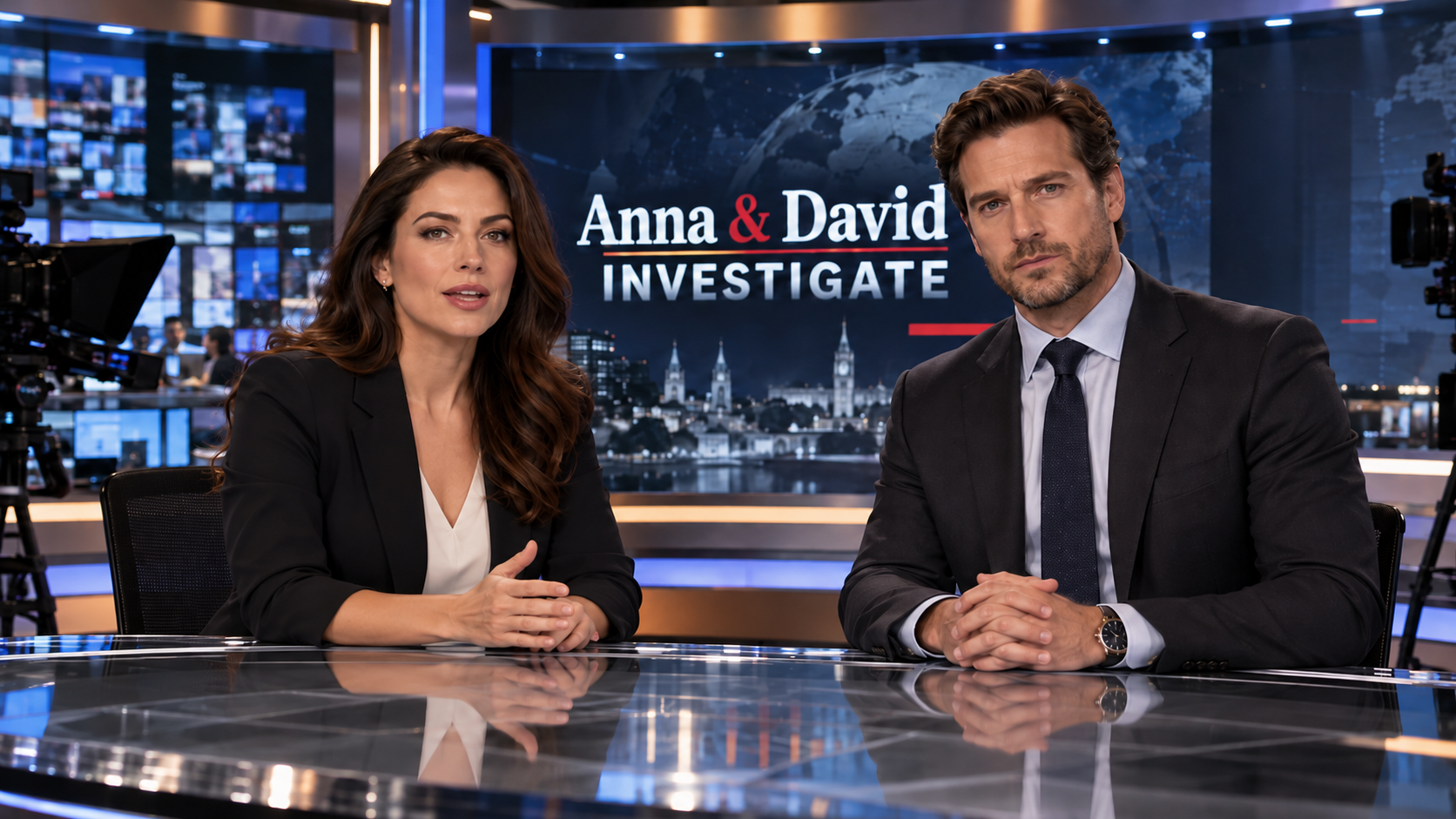
An independent discussion of three articles published on The Stealing of Emily.
DAVID: Welcome back. Today, Anna and I are examining three articles by Martin Newbold, published on The Stealing of Emily. They raise difficult questions about Sir Keir Starmer, the Crown Prosecution Service, child safeguarding, and the consequences of family separation.
ANNA: And we’re going to approach them as independent commentators. Not simply repeat the allegations, but examine the arguments, the documents behind them, and what questions remain unanswered.
DAVID: The three articles were published between June and November 2026. They concern different events and different periods, but the same political figure appears throughout: Keir Starmer.
Part One — Keir Starmer’s Legacy and Family Separation
ANNA: The first article, published on 26 June 2026, is titled Kiers Starmers Abuse of Children and Parents — A Legacy.
It challenges changes to family-court legislation and safeguarding policy, particularly the government’s proposal to remove the statutory presumption that parental involvement generally benefits children.
DAVID: The government’s argument is that children’s safety must come first, particularly where domestic abuse is involved. That’s a serious and legitimate concern.
But Newbold raises another question. What happens when safeguarding assessments are inaccurate, exaggerated, or based on information that families cannot effectively challenge?
ANNA: That’s the issue I find worth exploring. A legal safeguard designed to protect children must also contain safeguards against mistakes.
If a report is materially inaccurate, the consequences could be enormous. A parent might lose contact, a child might lose an important relationship, and years might pass before an error is recognised.
DAVID: Newbold also describes contacting approximately 640 MPs about Emily, receiving thousands of responses and acknowledgements without, according to his account, obtaining an answer to his central safeguarding question.
Now, correspondence alone cannot establish that authorities acted unlawfully. But if those figures and responses are documented, they provide a substantial record of attempts to obtain information.
ANNA: And that raises a very practical accountability question. Who is responsible for resolving an enquiry that repeatedly passes between departments and public officials?
A referral is not necessarily a resolution. An acknowledgement is not an investigation. And a completed administrative process does not automatically mean the underlying concern has been answered.
Part Two — The CPS Warning Notices
DAVID: The second article, published on 10 November, is titled The Truth About Keir Starmer or a Blair Redaction?
This one examines Starmer’s earlier career as Director of Public Prosecutions and the use of Child Abduction Warning Notices.
ANNA: There is an important original document here. The Crown Prosecution Service’s 2010–2011 report confirms that the CPS worked with the Association of Chief Police Officers on drafting and agreeing these notices.
The report contains a foreword by Keir Starmer, who was Director of Public Prosecutions at the time.
DAVID: So there is a documented institutional connection. That’s established.
But here’s the question: were these notices used to protect children while investigators gathered evidence, or were they sometimes used where criminal proceedings should already have been pursued?
ANNA: The distinction matters enormously. A warning notice is not a conviction, and breaching a notice is not itself a separate criminal offence.
Official guidance explicitly says such notices must not replace prosecution of criminal behaviour.
DAVID: Which makes the investigation into their actual use important.
If credible evidence of serious sexual offending existed, but police relied on a warning letter and failed to investigate further, the decisions in those individual cases deserve scrutiny.
ANNA: And responsibility needs to be traced accurately. Who made the decision? Was there a CPS charging referral? What evidence existed at that stage? Did investigators return to the case? Was the child subsequently protected?
Those questions are more informative than assuming every notice represented a failed prosecution.
DAVID: The article also discusses a historical Annex A template from archived CPS legal guidance. Newbold has been attempting to recover the original document and establish its approval history.
ANNA: A complete authenticated copy would certainly help clarify the wording and provenance. But the historical CPS report already gives us something concrete: confirmation that the drafting work took place during Starmer’s tenure.
It doesn’t establish that Starmer personally ordered the misuse of those notices. That question would require additional evidence.
DAVID: My view is that the crucial test is not merely whether a policy existed. It’s whether the policy achieved its intended purpose in practice — and whether children were exposed to avoidable harm when it failed.
Part Three — Four Families and the Lost Generations
ANNA: The third article, Four Families — The Generations Lost to Family Separation, published on 2 November, is different.
Here, the focus moves away from government institutions and towards the people affected by separation.
Newbold describes Lauren Cunningham’s 26 years of estrangement and Emily’s 19 years of separation, alongside the effects on siblings, grandparents and the wider families.
DAVID: And this changes the discussion considerably.
Government policy is normally measured through legislation, statistics, court decisions and administrative outcomes.
But how do you measure a childhood spent apart? A brother or sister never met? A grandparent who never gets to know a grandchild?
ANNA: Those are the questions that give this article its emotional force.
Of course, family separation sometimes protects children from serious harm. That cannot be ignored. But where separation has occurred, the justification, evidence, review process and possibilities for maintaining safe family relationships should be open to proper scrutiny.
DAVID: The article also raises a question that doesn’t receive enough attention: what happens after the original decision?
Suppose a family believes there has been a fundamental error. Is there an effective mechanism to examine new evidence years later? Can inaccurate records be corrected? Can relationships be restored where it is safe and in the child’s interests?
ANNA: And who considers the extended family?
The effects don’t necessarily stop with the two parties named in a court order. They may extend across siblings, generations and whole family networks.
DAVID: This is where the three articles connect. The June article questions policy and accountability. The November CPS article examines historical prosecutorial practice. And Four Families examines the human cost when family relationships are lost.
They’re not proof of one coordinated wrongdoing, and the events described do not all fall within Starmer’s direct responsibility.
But they do invite us to examine whether institutions have effective mechanisms for recognising errors and answering serious concerns.
Part Four — Our Assessment
DAVID: Anna, having read all three, what do you think the most important question is?
ANNA: Whether accountability continues after an official decision has been made.
A safeguarding decision can be necessary, lawful and protective. It can also be challenged, investigated or, where evidence warrants it, corrected.
What I want to know is whether the system provides a meaningful route for doing that.
DAVID: For me, it’s the difference between having procedures and demonstrating outcomes.
A police warning, a government reply, an assessment, a case review — each can serve a purpose. But the real question is whether the child was protected and whether the relevant evidence was properly considered.
ANNA: And with Starmer occupying both his former position as Director of Public Prosecutions and his later position as Prime Minister, the articles ask readers to examine two distinct types of responsibility: historical institutional oversight and present government policy.
Neither role automatically proves personal responsibility for every failure alleged. But both can properly be examined through records, decisions and public accountability.
DAVID: There’s another point. The political controversy can sometimes dominate the story so completely that the children and families become secondary.
ANNA: And Four Families brings those human consequences back into focus.
Whatever position people take on family-court reform or prosecution policy, children deserve protection from abuse, accurate decision-making, and meaningful consideration of their family relationships.
DAVID: So our conclusion is that these three publications raise questions worth examining through original documents, individual case records and clear lines of responsibility.
ANNA: And where evidence is incomplete, the answer should be to establish what happened — not to replace unanswered questions with assumptions.
DAVID: Three articles. Different periods of government and public administration. One continuing concern about how the institutions responsible for children are held accountable.
ANNA: And one deeply personal question that remains at the heart of Martin Newbold’s work.
DAVID: Where is Emily?
ANNA: And what can be established, independently and transparently, about what happened to her?
DAVID: You’ve been listening to Daniel and Anna, reviewing three investigations published at thestealingofemily.co.uk.
ANNA: Thank you for listening. Until next time.



Leave a Reply