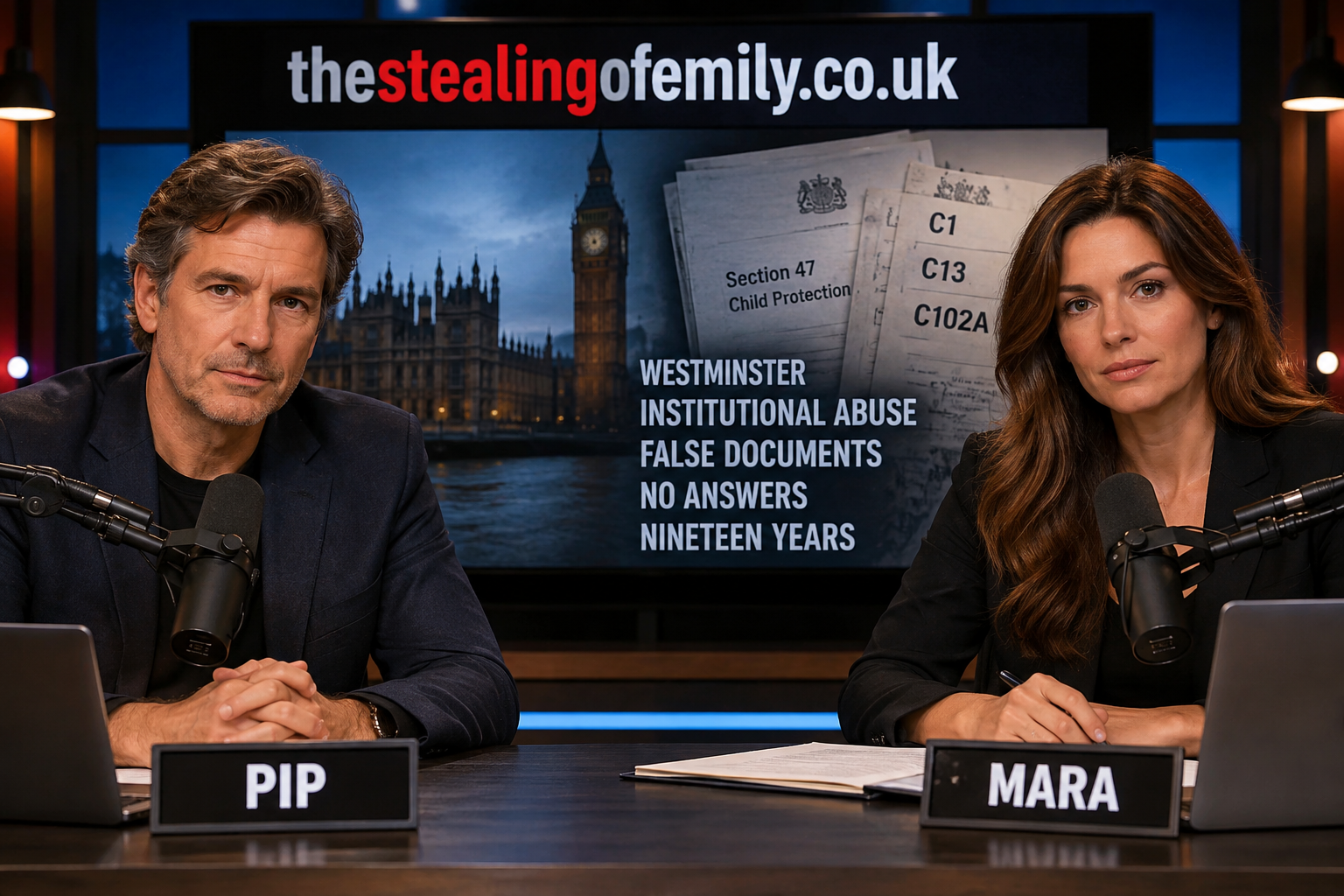
Pip: Welcome to thestealingofemily.co.uk — a site where the documents are the argument, the questions are nineteen years old, and the answers are still outstanding.
Mara: Martin Newbold has been publishing his account of what happened to his daughter Emily — and today’s posts cover three connected territories: institutional concealment of abuse linked to Westminster, the falsified court documents at the heart of Emily’s case, and the Section 47 safeguarding duty that he says was never properly fulfilled.
Pip: Let’s start with the Westminster backdrop that frames all of it.
What Westminster’s Inquiry Actually Found
Mara: The question here is what the official record actually established — not the shorthand version, but what IICSA’s Westminster investigation concluded after examining allegations of organised abuse, cover-up, and institutional protection of offenders.
Pip: The post draws the boundary carefully, quoting the inquiry’s own conclusion: “ample evidence of individual child-sexual-abuse perpetrators linked to Westminster” — alongside significant institutional failures where authorities “turned a blind eye, actively shielded perpetrators, and covered up allegations.”
Mara: So the upshot is a precise distinction: no organised Westminster paedophile network was established, but individual perpetrators connected to Westminster were, and institutions repeatedly put reputation ahead of child protection. Those are two very different findings from a blanket denial.
Pip: The post walks through the documented strands — Operations Fairbank, Fernbridge, Midland, Circus, and Jordana — and the Dickens dossier, where Special Branch allegedly removed material from a journalist’s office.
Mara: Operation Circus is particularly pointed: a former detective chief inspector testified that officers were briefed that if prominent members of society were identified, the inquiry should cease. IICSA considered that recollection likely genuine.
Pip: The chronology the post constructs — Dickens raising Hayman in Parliament in 1981, Geoffrey Prime prosecuted in 1982, Operation Circus following around 1985 — sits directly alongside the period when Churchtown was active. That’s a timeline observation, not a proven connection.
Mara: Which is exactly the post’s framing: it identifies what contemporaneous records would need to exist to turn a hypothesis into evidence. That discipline matters here, and it carries forward into the Emily case itself.
Nineteen Years, False Documents, No Answers
Mara: The central claim in “The Truth They Don’t Want You to See — 19 Years and Counting” is not that the system made errors — it is that the foundational court documents were deliberately falsified, and that every official channel pursued since has failed to address that.
Pip: The post names Forms C13, C1, and C102A — the documents that tell a court who the parents are — and identifies a specific internal contradiction: Form C13, transmitted at 12:56 on 2 February 2010, states that “little is known about Mr Keenan or his family,” while Form C1, transmitted one minute earlier, gives Keenan’s full name, address, and purported parental status.
Mara: What this means in practice is that both documents cannot be accurate, and the post asks the obvious follow-up: what evidence was relied upon to identify Keenan as Lauren’s father, and who supplied that information?
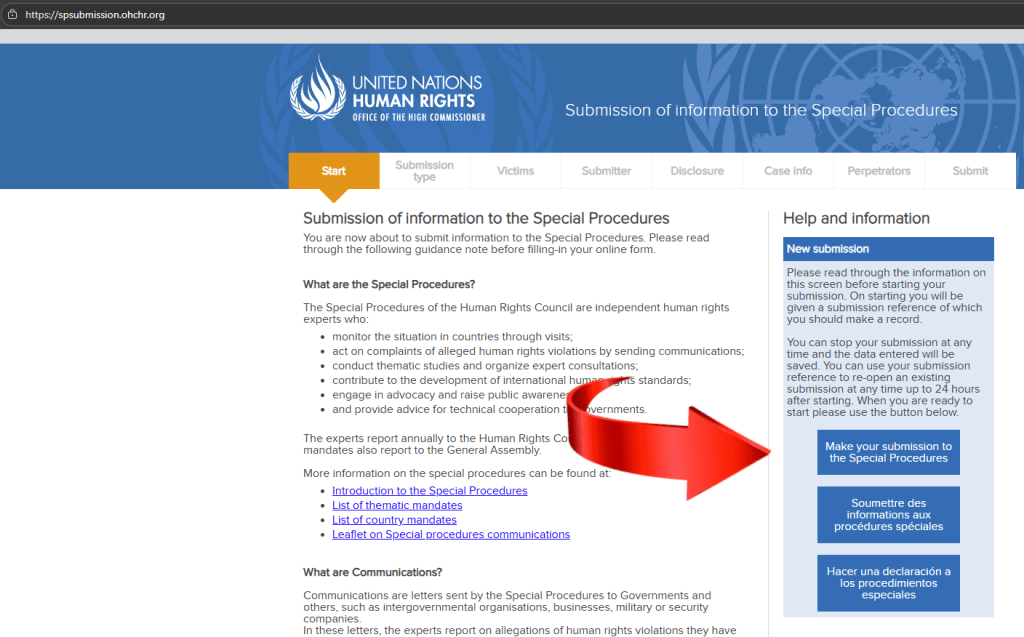
Pip: The post is unsparing about the scale of what followed that contradiction — complaints to the Serious Fraud Office, the ICO, IBAC in Victoria, OVIC, the United Nations Human Rights office, the Local Government Ombudsman. Reference numbers across multiple continents.
Mara: And the post quotes the human cost directly: “The people identified above made it impossible for me to have my happily ever after. Through the actions taken in these proceedings, I was left destitute.”
Pip: The Podcast Episode on Child Protection and Accountability extends this outward — it covers the formal letter demanding answers on who warned Matthew Dunkley before his suspension in Victoria and who authorized his departure, invoking the same adverse-inference principle: silence and withheld records are not proof of innocence.
Mara: The post is explicit that the false documents still stand. Every reference number is a record of a question that has not been answered. That is the thread connecting Westminster’s institutional failures to what the site documents about Emily.
Pip: From falsified documents to the safeguarding process that preceded them — the question of what Section 47 actually required comes next.
The Section 47 Question East Sussex Has Not Answered
Mara: The tension in the East Sussex Section 47 Offences post is a statutory one: what does the Children Act 1989 actually require before a child is removed from a parent’s care, and was that requirement met when Emily was taken from her father’s care at his mother’s home?
Pip: The post quotes the Act directly: the local authority “shall make, or cause to be made, such enquiries as they consider necessary” to decide what safeguarding action should be taken — and the post is precise that “shall” is a duty, not a discretion.
Mara: What this gets the reader is a sharper question than simply whether the decision was right or wrong: if no assessment of Martin or of Emily in that placement occurred, what Section 47 enquiries did East Sussex actually undertake before intervening?
Pip: And there is a specific piece of positive evidence that sharpens this further. He voluntarily sought out a Solihull parenting assessment through another local authority, completed the six-week course, passed it — and says the East Sussex social worker dismissed it without a recorded reason.
Mara: The East Sussex Section 47 Offences Podcast works through the next layer: allegations that Christine Stirling attended supposedly independent expert assessors shortly before Martin arrived for his own assessments, and that at Action for Children, an employee told both Martin and his mother that Stirling was there to write the court report herself.
Pip: That allegation is presently witness evidence, and the post is careful to say so. The evidential chain it constructs is: who was commissioned, who actually interviewed Martin, who drafted the report, who signed it, and whose language is actually in it. Authorship, the post notes, can leave fingerprints.
Mara: The post also identifies a genogram submitted to the court containing fundamental errors in Emily’s family relationships — Collette recorded as biologically related to Emily when she was not, Gerard recorded as Lauren’s father when he was not. These are not peripheral details; they became part of the factual architecture on which decisions were made.
Pip: The Emily Newbold and Juliette Lewin side-by-side synopsis places this alongside the case of a grandmother whose repeated safeguarding concerns about her granddaughter were dismissed without adequate investigation — the mirror image of the same procedural failure, from the opposite direction.
Mara: Both cases reduce to the same testable documentary question: what safeguarding enquiries were actually performed, what evidence did the authority possess, and does the contemporaneous record support the decision that was eventually made?
Pip: The post puts it plainly — not a verdict, but a question capable of being answered by records, assessments, chronology, and evidence.
Mara: An inquiry that found institutional failures without an organised network, court documents that contradict each other on the same morning, and a safeguarding duty that the post says was never properly discharged — the site keeps returning to the same question: did the process follow the evidence, or run ahead of it?
Pip: Nineteen years of reference numbers suggest the answer they keep getting. More from thestealingofemily.co.uk next time.



Leave a Reply