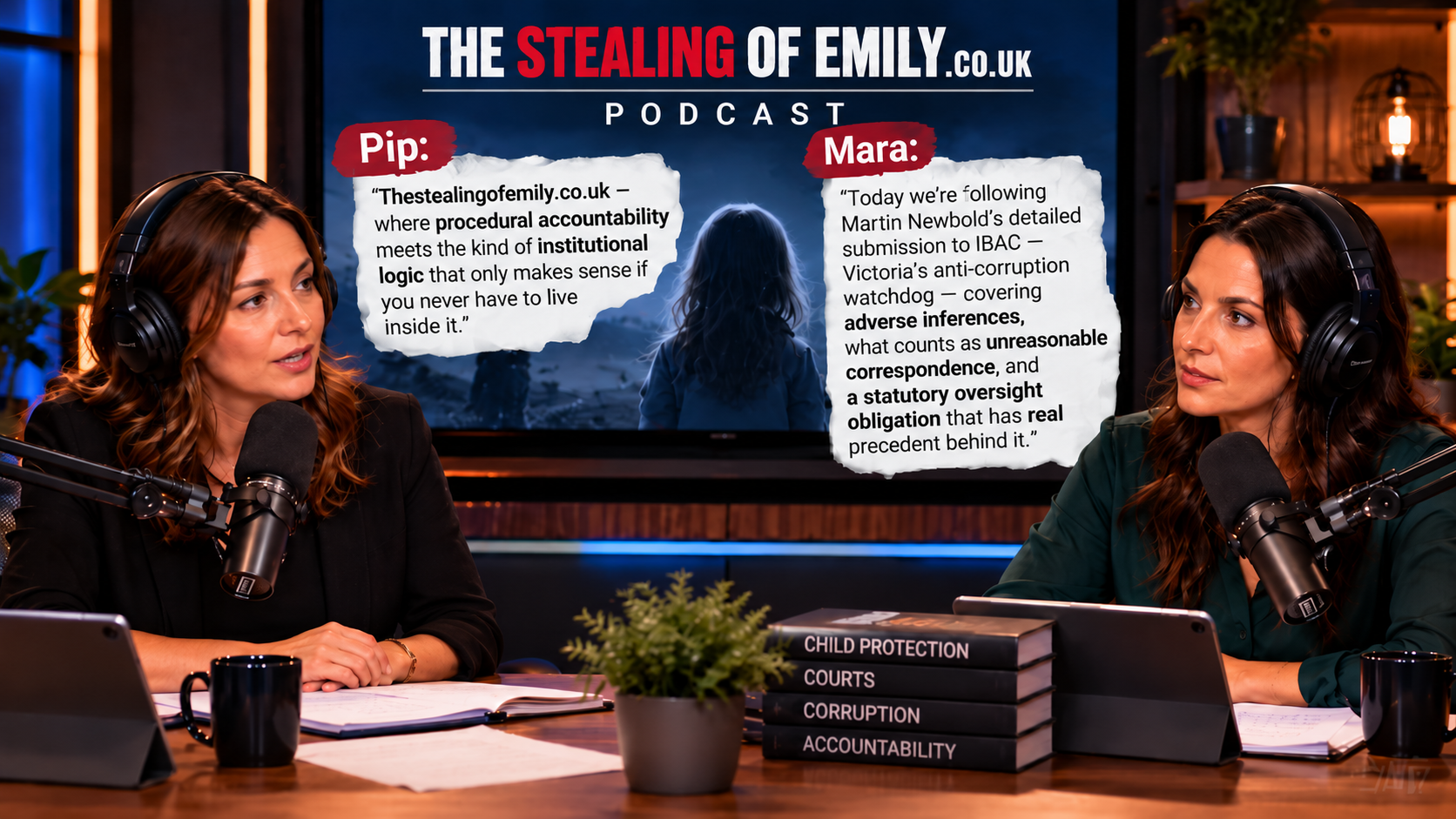
Pip: Welcome to thestealingofemily.co.uk — a site where the documents are the argument, the questions are nineteen years old, and the answers are still outstanding.
Mara: Martin Newbold has been publishing his account of what happened to his daughter Emily — and today’s posts cover two connected territories: the Section 47 child protection process that he says was never properly followed, and a broader pattern of alleged concealment stretching from East Sussex to Victoria, Australia.
Pip: Let’s start with the safeguarding duty at the center of it all.
—
What Section 47 Actually Required
Mara: The core tension here is a statutory one: what does the law actually require before a child is removed from a parent’s care, and was that requirement met in Emily’s case?
Pip: The East Sussex Section 47 Offences post sets this up directly. The statutory language is precise — Section 47 of the Children Act 1989 says the authority “shall make, or cause to be made, such enquiries as they consider necessary” to decide what safeguarding action should be taken.
Mara: That word “shall” carries weight. It is a duty, not a discretion. And the post is careful to note that Section 47 itself does not literally require a home assessment before removal — the assessment obligations come from the wider safeguarding framework surrounding that duty.
Pip: Which makes the factual gap harder to paper over, not easier. If the framework required assessing the child’s circumstances with the carer, and no such assessment occurred, the authority cannot truthfully represent to the Family Court that one did.
Mara: The post puts it plainly: “If a worker knowingly places materially false information before the court, verified as true, in order to obtain an order removing a child, the issue goes beyond a defective assessment: it raises the question of knowingly false evidence being used to procure a court order.”
Pip: And there is a specific piece of positive evidence that sharpens this. He voluntarily sought out a Solihull parenting assessment through another local authority, completed it, passed it — and says the East Sussex social worker dismissed it without recorded reason.
Mara: The post does not claim that passing the Solihull course settles every safeguarding question. But it asks the obvious follow-up: what weight was given to it, why was it rejected, and what assessment evidence was being relied upon instead?
Pip: The Emily Newbold and Juliette Lewin side-by-side synopsis widens the frame. It places Emily’s case next to that of Juliette Lewin, a grandmother who says her repeated safeguarding concerns about her granddaughter were dismissed without adequate investigation — the mirror image of the same procedural failure, from the other direction.
Mara: The synopsis identifies what it calls the common testable documentary question across both cases: what safeguarding enquiries were actually performed, what evidence did the authority possess, and does the contemporaneous record support the decision that was eventually made?
Pip: The podcast episode on Section 47 works through the same chain methodically — false statement, documentary contradiction, when the contradiction reached the court, what the judge knew, what he did. It is less interested in naming offences than in building the evidential sequence that would make any allegation stick.
Mara: That discipline matters. The post is explicit that a contradiction in evidence is not automatically perjury. Under the Perjury Act 1911 you need a material statement in judicial proceedings, made by someone lawfully sworn, who knows it to be false or does not believe it to be true.
Pip: So the question is not just what was said — it is what was known.
Mara: Which brings us to the allegation of concealment, and how far that question travels.
—
Falsified Documents And Unanswered Questions
Mara: The post titled “The Truth They Don’t Want You to See — 19 Years and Counting” shifts from process failure to something more direct: the claim that foundational court documents were deliberately falsified.
Pip: The post names Forms C13, C1, and C102A — the documents that tell a court who the parents are. It alleges that Gerard Keenan was named as Lauren’s father and Martin as her stepfather, and states: “The people identified above made it impossible for me to have my happily ever after. Through the actions taken in these proceedings, I was left destitute.”
Mara: The post identifies a specific internal contradiction: Form C13, transmitted at 12:56 on 2 February 2010, states that “little is known about Mr Keenan or his family.” Form C1, transmitted one minute earlier, gives Keenan’s full name, address, and purported parental status. The post asks how both can be accurate.
Pip: Nineteen years of complaints, reference numbers across multiple continents, and the documents, he says, still stand.
Mara: The formal letter to IBAC about Matthew Dunkley extends that pattern outward. It alleges that Dunkley, formerly a senior education official in Victoria, was warned before his suspension, that evidence was destroyed beforehand, and that he left Australia without an documented exit route. The letter demands written answers on who warned him and who authorized his departure.
Pip: The same adverse-inference principle the post invokes against IBAC — that silence and withheld records are not proof of innocence — is the same logic running through every layer of this site.
Mara: And that thread connects back to Emily.
—
Pip: A statutory duty to inquire, documents that contradict each other, and nineteen years of unanswered reference numbers — the question the site keeps returning to is whether the process followed the evidence, or ran ahead of it.
Mara: Next episode, more from thestealingofemily.co.uk as the record continues to build.




Leave a Reply