Pip: If you have ever wondered whether the phrase “the system is working as designed” could be both reassuring and deeply alarming at the same time, thestealingofemily.co.uk is here to help you hold both feelings at once.
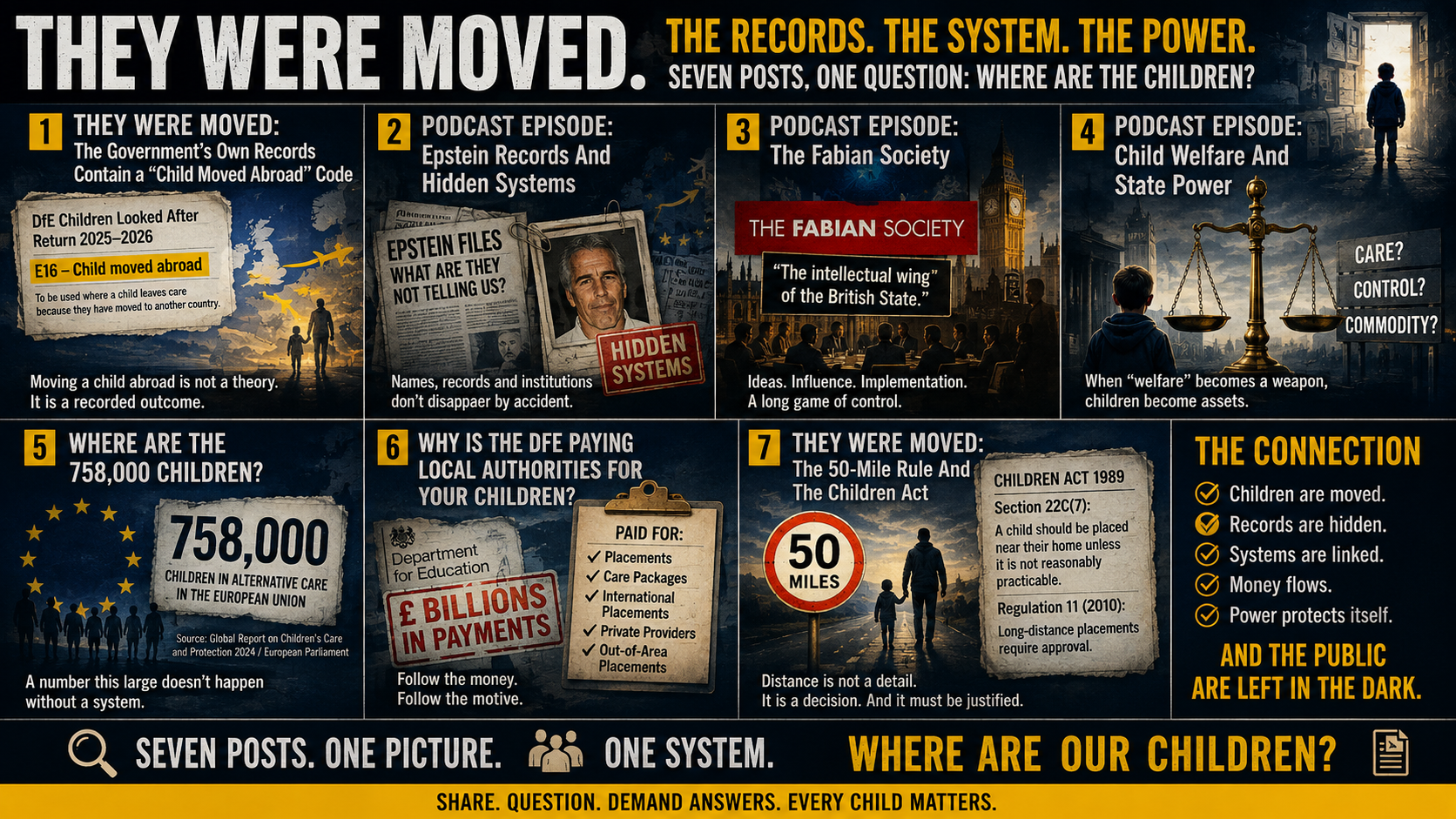
Mara: Martin Newbold has been publishing across connected territories this week — how child removal and care funding is structured in law, where the ideological roots of state paternalism actually come from, and what the documentary record around Epstein and missing case files reveals. Let’s start with the money, the legislation, and the question of where children go.
Who Pays, and Why: The Funding Behind Child Removal
Pip: The central tension here is whether a financial incentive is built into the child removal system — and if so, whether that incentive shapes outcomes rather than just following them.
Mara: The post “Why is the DFE paying local Authorities for your children?” traces the legal architecture carefully. The key passage from the Apprenticeships, Skills, Children and Learning Act 2009 reads: “In exercising their functions, a children’s services authority in England must act in the manner best calculated to secure that any safeguarding targets set under this section are met.”
Pip: So the upshot is that councils are not merely encouraged to hit targets — they are legally required to. And separately, the funding regulations attach money to those outcomes.
Mara: The post is precise about the separation. Section 195 creates the duty to meet targets. Section 199 creates the payment power. They are different sections of the same Act, but in practice they operate together — meeting the targets brings in the money, with per-child base rates documented between roughly thirty-one and forty-three thousand pounds per year, rising far higher for complex placements.
Pip: The stick and the carrot, written into law in adjacent sections. Tidy.
Mara: That structural point connects directly to “They Were Moved,” which asks what happens once a child enters that system and is placed at distance. Parliament recorded in 2025 that 7,350 looked-after children were living more than 50 miles from home, including 3,120 more than 100 miles away.
Pip: And the post raises a sharper question than just distance. If a child crosses an international border, where is the statutory decision-making record showing who authorised that move, what alternatives were considered, and how family contact was protected?
Mara: The Government’s own data system has an answer of sorts. The Department for Education’s Children Looked After Return 2025 to 2026 contains a specific reason code for a child leaving care: E16 — Child Moved Abroad. The guidance states it is used where a child leaves care because they have moved to another country.
Pip: A code exists. Which means the outcome is not theoretical — it is documented, counted, and filed. The question the post presses is: how many times has that code been used, which countries, which authorities, and who verified the child’s welfare afterward?
Mara: And that cross-border audit question becomes harder when the “Podcast Episode: Child Welfare and State Power” adds the conviction layer — 255 independently verified convictions drawn from police, court, and inquiry records, including 87 public office-holders. Two of those office-holders voted on the safeguarding bill designed to catch exactly that kind of offending, and neither declared a conflict of interest before the vote.
Pip: The pattern the database is building is that the failure is not isolated to any single layer. It runs from Parliament down through town halls and into individual children’s homes.
Mara: Which raises an obvious question about the ideological foundations underneath all of it — and that is where the history comes in.
The Long Shadow: Ideology, Migration, and Disappeared Records
Pip: The question “Podcast Episode: The Fabian Society” is really asking is where the phrase “we can look after your children better than you” actually comes from — because it has a specific intellectual ancestry.
Mara: The post quotes the core logic directly: “the state, guided by scientific experts, was seen as more capable of raising healthy, useful citizens than poor, ‘unfit,’ or ignorant parents.” Founded in 1884, the Fabians shaped progressive thought for decades before Nazi eugenics made the consequences visible.
Pip: State removal framed as science — that is the move that makes it so durable.
Mara: “Where are the 758,000 Children?” connects that ideology to practice. From the 1860s to 1970, Britain transported over 130,000 children to Australia and Canada without parental knowledge — many were not orphans. The post argues the mechanism is structurally identical today: move the child across a jurisdiction, alter the name or date of birth, and the registers cannot connect the dots.
Pip: History as a blueprint nobody filed under “lessons learned.”
Mara: The post frames the unanswered audit question plainly: of the 758,000 children recorded in alternative care across EU Member States, how many can be reconciled to subsequent official identity, education, and health records — and how many cannot?
Documents That Shift, Ashes That Vanish
Pip: The records theme is about what happens when you try to verify the paper trail — and the paper trail keeps changing depending on which name you use.
Mara: “Podcast Episode: Epstein Records and Hidden Systems” states directly: “Documents published in UK National Archives show Tony Blair met Jeffrey Epstein at Downing Street on 14 May 2002.” The post calls for a full investigation of records between Downing Street, the Treasury, and local authorities in relation to Epstein’s network — not an accusation of guilt, but a demand the documentary trail be examined rather than closed off.
Pip: What this means in practice is that the ask is procedural. If the records exist, open them. If they have been redacted, justify the redaction under law rather than convenience.
Mara: The cremation records for Cathryn Louise Peters make that point concrete. On 20 September 2023, Hastings confirmed no cremation in that name. The very next day, after different name details were supplied, they confirmed a cremation on 7 June 2010. The ashes were collected by funeral directors and never returned. No family member was informed.
Pip: Two different answers on consecutive days, depending on which name you use. That is not clerical error — that is the kind of discrepancy that makes every subsequent silence look deliberate.
Mara: And the related post on Locate International asks whether emails from the missing-persons charity can be traced to a physical sender. The answer is no — the IP address points to relay infrastructure, not a location. Documents that shift names overnight, ashes that disappear without family notice, emails that mask their origin. The common thread is institutional opacity dressed as procedure.
Pip: Targets that carry funding, codes that count children moved abroad, registers that cannot see each other — the architecture keeps doing the same thing in different rooms.
Mara: And the ideological thread the Fabian post pulls on suggests that architecture was not accidental. The questions being asked now about children, data, and state power look a lot less modern once you know where they started.


Leave a Reply