THE 50-MILE QUESTION
The Government’s own figures show thousands of looked-after children being placed more than 50 miles from home.
That matters because the Children Act 1989 does not give local authorities an unrestricted power to move children wherever they choose.
Section 22C requires authorities, so far as reasonably practicable, to place a looked-after child near their home and to protect their education, family relationships and welfare.
Where a placement is outside the authority’s area, additional statutory safeguards apply.
Under Regulation 11 of the Care Planning, Placement and Case Review (England) Regulations 2010, an “at a distance” placement requires approval at Director of Children’s Services level, together with consultation and evidence that the placement is the most appropriate available placement for that particular child.
Government safeguarding guidance has also recognised placements exceeding 50 miles as sufficiently significant to warrant the heightened scrutiny associated with distant placements.
So if a child was moved 50, 100 or hundreds of miles away — and particularly if that child was subsequently moved abroad — the question is not merely:
Where did they go?
It is:
Where is the statutory decision-making record showing why that distance was necessary, who authorised it, what alternatives were considered, how family contact was protected, and why the placement remained consistent with the child’s welfare?
And if the child then crossed an international border:
Where is the additional legal authority permitting that international move?
The question is changing.
For months the question has been:
Where are the children?
But the Government’s own documentation now raises a more precise question:
How many children were moved — and where were they moved to?
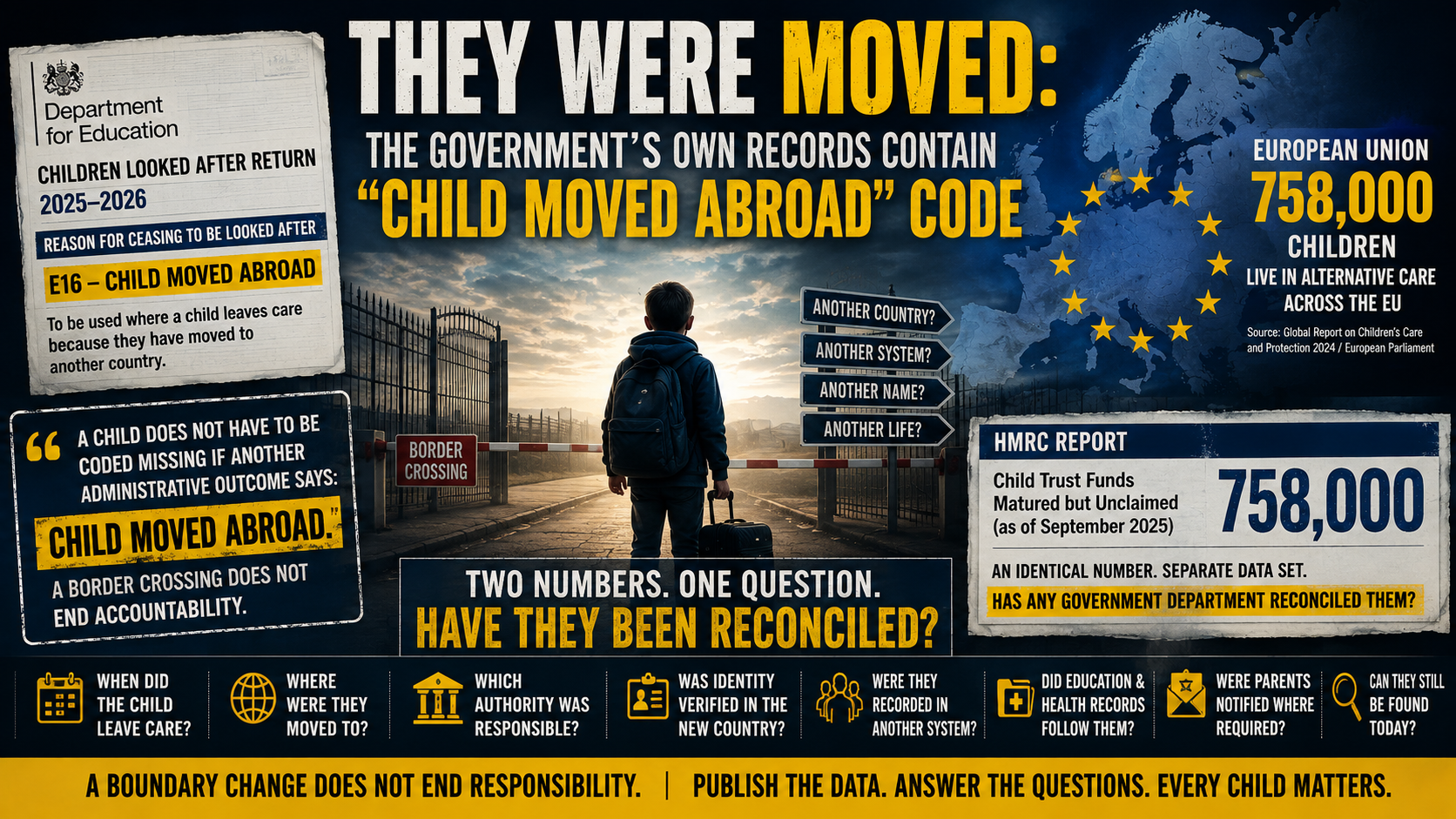
The Department for Education’s official Children Looked After Return 2025–2026 contains a specific reason code for a child leaving care:
E16 — CHILD MOVED ABROAD
The DfE guidance states that E16 is to be used where a child leaves care because they have moved to another country.
That matters.
Moving a looked-after child abroad is therefore not some theoretical possibility being invented by campaigners. It is an outcome recognised and coded within the Government’s own national children’s social-care data system.
So where are the figures?
How many children have been recorded under E16?
Which countries did they move to?
How old were they?
Which local authorities were responsible for them?
Who subsequently verified their identity, education, health records and welfare?
And, crucially:
Can those children still be reconciled across national systems after they cross the border?
NOW LOOK AT THE EUROPEAN FIGURE
A major 2024 international report states that approximately:
758,000 CHILDREN
live in alternative care in the European Union.
The European Parliament has separately referred to the same estimate when discussing violence against children in the EU and acknowledges that the exact number of children in alternative care is not known.
That does not, by itself, prove that these are children transported from Britain.
But it makes the audit question unavoidable.
If the UK Government records children leaving care because they have “moved abroad”, and hundreds of thousands of children are simultaneously recorded within alternative-care systems across European Union Member States:
WHERE IS THE CROSS-BORDER RECONCILIATION?
Who checks that Child A leaving one country’s system is the same Child A entering another country’s system?
Who verifies the name?
Who verifies the date of birth?
Who verifies parental identity?
Who verifies nationality?
Who verifies the child’s previous care history?
Who tells the parents?
cite:
- That is not a “theory” — that is how the system functions in practice. Whether one section says it all, or two separate sections work together — the effect is identical.
- A 2024 global report says 758,000 children in EU Member States were in alternative care in 2021. cite https://bettercarenetwork.org/sites/default/files/2024-10/global-report-on-childrens-care-and-protection-2024.pdf
- HMRC says 758,000 UK Child Trust Fund accounts had matured but remained unclaimed in September 2025. cite https://www.gov.uk/government/news/savings-stash-worth-thousands-waiting-for-758000-young-people
For long-distance placements, Regulation 11 of the Care Planning, Placement and Case Review (England) Regulations 2010 is crucial. A placement outside the authority area must be formally approved, and where it is an “at a distance” placement — outside the responsible authority and outside any adjoining authority — it must be approved by the Director of Children’s Services. The Director must be satisfied that it is the most appropriate placement, relatives have been consulted where appropriate, the receiving authority has been consulted and given the care plan, and the IRO has been consulted.
The 50-mile figure has been used as an important long-distance benchmark. Earlier safeguarding guidance said that even where the receiving authority adjoins the home authority, a placement in excess of 50 miles may properly be treated with the same heightened scrutiny as an “at a distance” placement. cite: https://www.childrenssociety.org.uk/sites/default/files/2020-10/no-place-at-home.pdf
And Parliament recorded in 2025 that 7,350 looked-after children were living more than 50 miles from home in 2024, including 3,120 more than 100 miles away. cite https://questions-statements.parliament.uk/written-questions/detail/2025-02-21/32553/
- The Effrontery of people who support crime with children?
- House of Lords Inquiry into Children’s Social Care — Time Is Running Out to Submit Evidence
- Re: East Sussex County Council Children’s Services – Emily Newbold
- Podcast Episode: Power, Abuse, And AI Oversight
- Why is Sir Tony Blair Hiding public meetings and data?




Leave a Reply