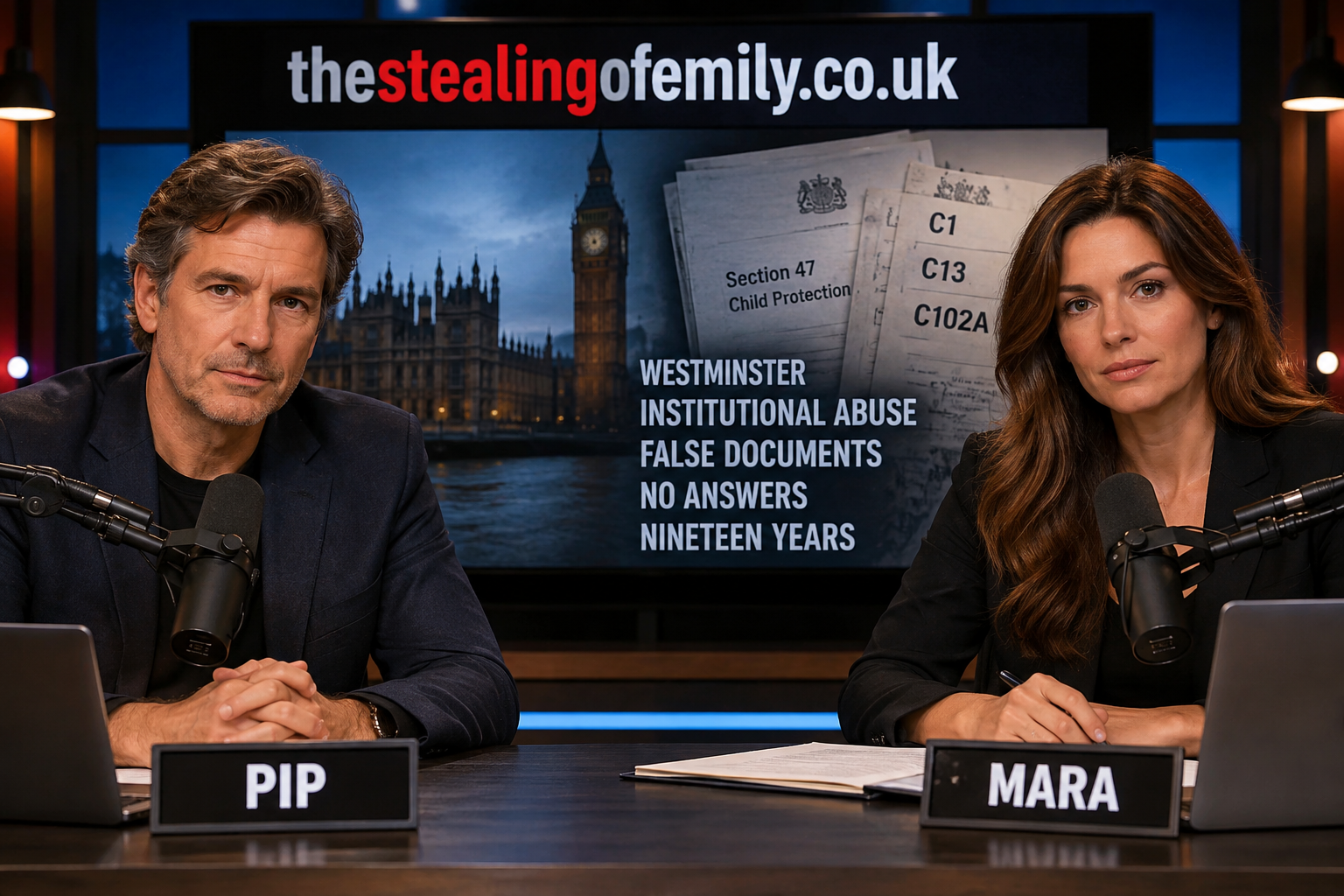
[Pip]: Welcome to thestealingofemily.co.uk — a site where the phrase “show the process that produced the decision” does a lot of heavy lifting, and rightly so.
[Mara]: This episode covers work by Martin Newbold across three areas: what official inquiries actually found about Westminster and institutional child protection failures, questions raised about Jeffrey Epstein’s death, and a detailed look at the Section 47 process in Emily’s own case. Let’s start with what the official record says about Westminster.
What IICSA Actually Found — and What It Didn’t
[Pip]: The shorthand version of the Westminster abuse story is either “there was a paedophile ring” or “it was all conspiracy theory.” The post here is doing something more careful than either of those.
[Mara]: The post works through the IICSA findings directly. The key formulation is this: “IICSA did not find evidence of an organised Westminster paedophile ring/network,” but it did find, in its own words, “ample evidence” of individual child-sexual-abuse perpetrators linked to Westminster, alongside significant institutional failures.
[Pip]: So the inquiry distinguished between an organised network — which it did not establish — and individual perpetrators who happened to move in Westminster circles, which it did establish. That is not a small distinction.
[Mara]:And the institutional failures were documented in detail. The post lists operations Fairbank, Fernbridge, Midland, Circus, and Jordana — each investigating a different strand, from Elm Guest House to allegations that a 1984 Piccadilly operation was closed early to protect prominent people.
[Pip]: Operation Jordana is the one that stays with you: an IOPC-managed investigation specifically into whether a police operation was shut down and evidence suppressed. That is the inquiry asking whether the inquiries were being stopped.
[Mara]: The Piccadilly strand is where IICSA’s findings are most concrete. Former DCI Howard Groves testified that officers were briefed that if prominent members of society were identified, the inquiry should cease. IICSA considered his recollection likely genuine, though it found no prominent suspect was actually encountered during Operation Circus.
[Mara]: The post also covers the Dickens dossier — material given to Home Secretary Leon Brittan in 1983 and 1984 — and journalist Don Hale’s account of Special Branch removing material from his office. IICSA examined that allegation rather than simply accepting it.
[Pip]: The post is careful to note that figures including Cyril Smith, Peter Morrison, Peter Hayman and Victor Montagu were examined, and that findings differ substantially between them. Nobody investigated gets flattened into a single category.
[Mara]: The “Churchtown was a hotbed” piece adds a chronological observation: 1981 to 1982, when Starmer reportedly worked at Churchtown, sits directly inside this broader period. The post is explicit that this does not connect Starmer or Churchtown to those offences — it is a timeline note about what contemporary records ought to exist.
[Pip]: Which is the disciplined version of the argument. Not “therefore he did it” but “here is what a contemporaneous paper trail would look like if a connection existed.”
[Mara]: And the “Churchtown was a hotbed” post has done considerable archival work on that paper trail — identifying the UCL Institute of Education file ABB/E/47, the Spastics Society’s 1979 and 1985 publications, and Mike Cotton’s 1981 book as sources that could place named personnel at Churchtown during Starmer’s reported period there. From Westminster’s institutional record, the next question is whether similar patterns appear in individual cases.
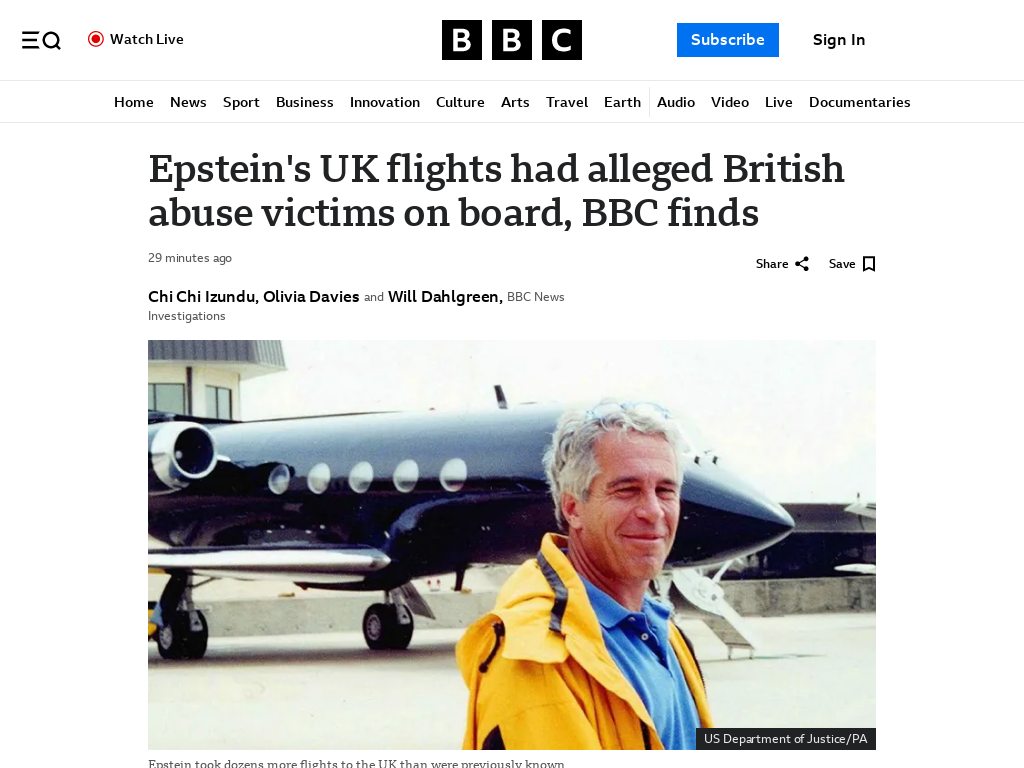
Epstein — The Medical Record That Doesn’t Add Up
[Pip]: The Epstein post leads with a forensic question rather than a conclusion, which is a better starting point than most coverage of this topic manages.
[Mara]: The autopsy states: “The prostate is slightly and diffusely enlarged, with marked enlargement of the verumontanum.” The post then sets that against LabCorp PSA reports from 2010 and 2018 that include guidance referencing radical prostatectomy, and notes that after complete surgical removal, the prostate cannot regenerate.
[Pip]: The post is careful about what that does and does not establish — the LabCorp guidance is standard text included for all PSA results, not proof of surgery. The unresolved question is whether surgery actually occurred.
[Mara]: There is also a 4chan chronology the post documents: an anonymous post at 4:15 AM on 10 August 2019 alleging an earlier movement, against the official 6:33 AM emergency alarm. The post treats this as an allegation requiring corroboration, not established fact. That forensic thread connects to the broader question of whether institutional records can be trusted.
The Section 47 Question — Process Before Verdict
[Pip]: The East Sussex Section 47 podcast episode takes a format that is either genuinely useful or a very good impression of one: two voices working through what the law actually requires before reaching any conclusion about what happened.
[Mara]:The central question is precise. Section 47 of the Children Act 1989 imposes a duty — the word is “shall” — on a local authority to make the enquiries it considers necessary to decide what action to take. The podcast asks: if Martin was caring for Emily at his mother’s home, what enquiries were actually carried out before she was removed?
[Pip]: And the Solihull evidence sits right at the heart of that. Martin voluntarily sought an assessment under another authority, completed a six-week course, passed it — and the post says that result was subsequently dismissed by the East Sussex social worker without recorded explanation.
[Mara]: The episode then documents a more serious allegation: that Christine Stirling attended supposedly independent expert assessors shortly before Martin’s own assessments with those experts. At Action for Children, Martin and his mother say they were told directly that Stirling was there to write the report.
[Mara]: The East Sussex Section 47 Offences article — the written piece the podcast is based on — frames this as a chain: Section 47 enquiries, the Solihull evidence, Stirling’s attendance dates, the expert reports, three dates in Stirling’s own court submission she could not later account for, and a genogram containing what the post identifies as fundamental errors in Emily’s recorded family relationships.
[Pip]: The genogram detail is the one that lands hardest — not because it is the most dramatic allegation, but because a document with wrong family relationships does not stay in a filing cabinet. It becomes part of the factual architecture for every decision that follows.
[Mara]: The episode is careful about what remains to be established. Contradictions in evidence are not automatically perjury. A judge relying on false evidence is not automatically complicit in producing it. The framework the podcast builds is evidentiary, not declaratory — and that discipline is what makes the questions hard to dismiss.
[Pip]: What ties all of this together is a single underlying problem: institutions that are supposed to produce independent records sometimes produce something else, and the gap between those two things is where the real investigation lives.
[Mara]: The work here is in the chronologies, the archive files, the dates in submitted documents. That is where the next episode will be too.



Leave a Reply