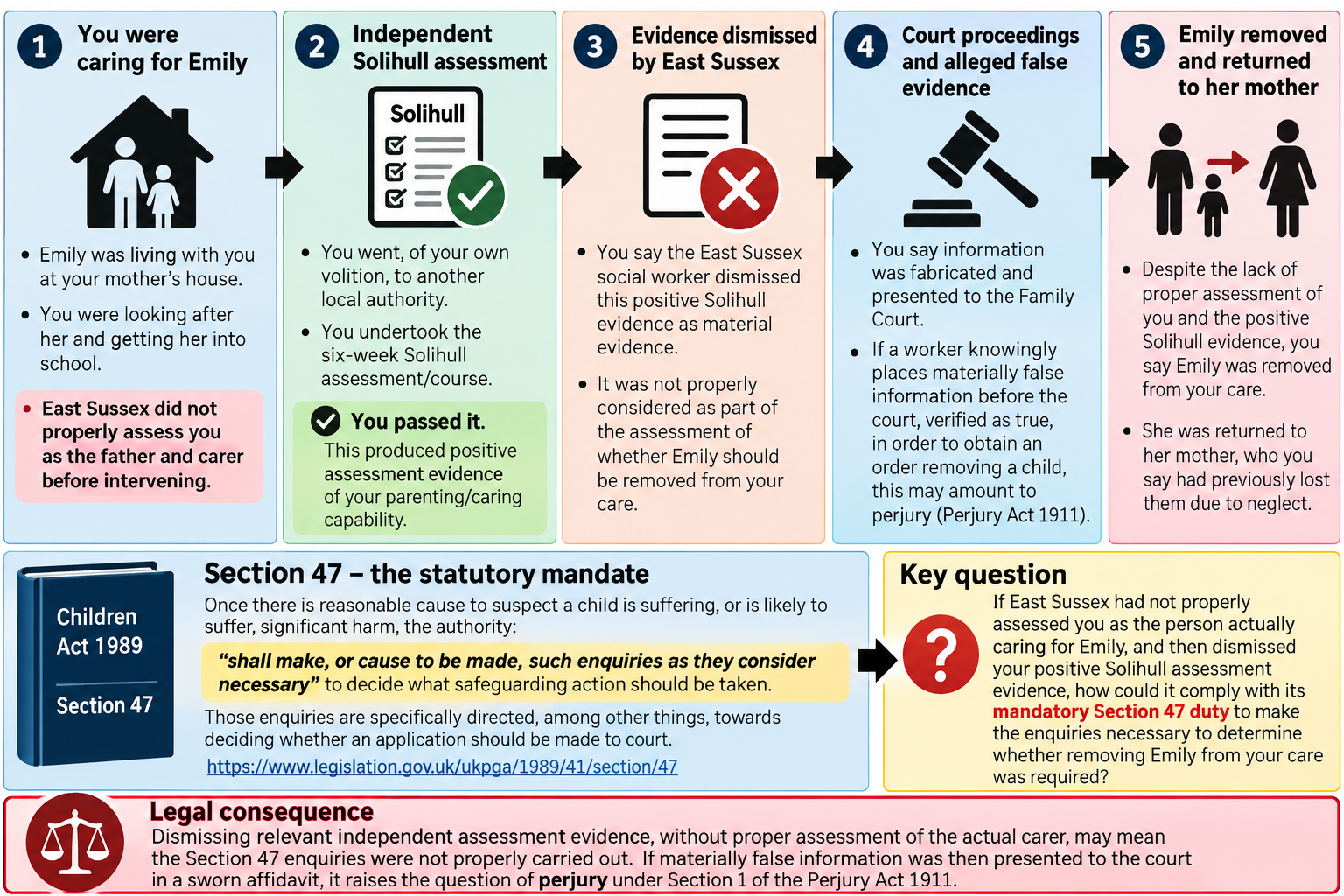
So tell me, how can a worker of the courts, or of the police, or of the council, come to my mother’s house, where I’m looking after my daughter, and getting her into school, come and take my daughter and give her back to her mother, when her mother then lost them by neglect, and effectively no proper assessment was done of me at all before the matter went to a court or the children were abducted with Hollis, where information was fabricated. If then Perjury was on the court to get an order to obtain my daughter and to force information to physically put her back with her mother when they had no right to interfere without assessment of me. This is further compounded that i chose to have assessment whilst in court as part of a course created in Solihull to ascertain i a person can adopt a child this was materially dismissed by social worker when it was a six-week course under examination.
I went, of my own volition, to another local authority and undertook the six-week Solihull assessment/course. I passed it. That positive assessment evidence was subsequently dismissed by the East Sussex social worker.
If no assessment of me the father or of the child’s circumstances in his care was undertaken, the East Sussex local authority cannot truthfully represent to the Family Court that such an assessment occurred or present invented findings as the product of one. If a worker knowingly places materially false information before the court, verified as true, in order to obtain an order removing a child, the issue goes beyond a defective assessment: it raises the question of knowingly false evidence being used to procure a court order.
Section 47 does not merely say the authority may gather whatever evidence supports the conclusion it already wants. Once the statutory threshold is engaged, the authority “shall make, or cause to be made, such enquiries as they consider necessary” to decide what safeguarding action should be taken. Those enquiries are specifically directed, among other things, towards deciding whether an application should be made to court. https://www.legislation.gov.uk/ukpga/1989/41/section/47
There are potentially serious legal issues in what has been described. Most people will want to separate the different legal questions rather than call the whole thing “perjury” without establishing who said what, under what oath, and with what knowledge.
If the document was a sworn affidavit submitted for the judicial proceeding, English perjury law is directly relevant. Section 1 of the Perjury Act 1911 covers a material statement made in a judicial proceeding by a person lawfully sworn where that person knows it is false or does not believe it to be true; it also expressly deals with statements made on oath outside the courtroom for purposes of judicial proceedings. https://www.legislation.gov.uk/ukpga/Geo5/1-2/6/pdfs/ukpga_19110006_en.pdf
Judicial immunity protects the judicial function; it is not a licence for criminal conduct. English authority expressly distinguishes immunity from civil damages for judicial acts from criminal liability where a judge is corrupt or perverts the course of justice. Nor does the Human Rights Act’s protection for a judicial act “done in good faith” answer an allegation whose very premise is deliberate bad faith, fraud or knowing participation in false evidence.
A judge’s judicial immunity is not the same thing as immunity from the criminal law. The CPS’s current guidance expressly lists “holders of judicial and quasi-judicial office (judges, magistrates, registrars, coroners)” among people who have been held to be public officers for the common-law offence of misconduct in public office.
The distinction is important. Judicial immunity principally protects judges against being personally sued over judicial acts. For example, the Human Rights Act specifically restricts proceedings and damages concerning judicial acts done in good faith. The Courts Act similarly provides statutory protection for justices acting within jurisdiction, while providing a different rule for certain conduct outside jurisdiction where bad faith is proved.
So my proposition was:
“A judge cannot be prosecuted for something criminal because judicial immunity protects them.”
then yes, that proposition is wrong.
I stated the proceedings were before Judge Hollis and alleges that Christine Elizabeth Stirling gave false evidence, that documentary records contradicted her testimony, and that a fabricated genogram was used concerning the Northern Ireland placement. It also records your allegation that Hollis’s court was told Stirling had gone to Northern Ireland and had stopped a police investigation. Your September article is actually quite careful: it says you are examining why allegedly false evidence wasn’t addressed and expressly says that you are not claiming anyone has been convicted of perjury.
A judge is not categorically protected from criminal prosecution by judicial immunity. The CPS expressly identifies judges, magistrates, registrars and coroners as people who have been held to be public officers for purposes of misconduct in public office.
What did Hollis know, when did he know it, what was he required or empowered to do as the judge, and is there evidence that his subsequent conduct was wilful rather than merely judicial error?
That’s a much stronger way of analysing what you’ve assembled.
There is also an important distinction concerning perjury. Under s.1 Perjury Act 1911, perjury requires a person lawfully sworn in a judicial proceeding to make a material statement which they know to be false or do not believe to be true. So if your evidence establishes that Stirling said X under oath while her contemporaneous records establish Y, that is highly relevant evidence, but the contradiction alone doesn’t automatically prove perjury. You still have to establish the materiality and the required state of knowledge/belief.
Where Hollis is concerned, your argument is different. If your proposition is that false evidence was knowingly permitted to determine what happened to Emily, the crucial evidential bridge is proving Hollis’s knowledge and wilfulness. The CPS definition requires wilful neglect/misconduct sufficiently serious to amount to an abuse of public trust; importantly, the CPS says “wilful” encompasses deliberately doing something known to be wrong or reckless indifference as to whether it is wrong. Mere negligence or even a serious mistake doesn’t meet that criminal threshold.
false statement → documentary contradiction → when contradiction reached Hollis → evidence Hollis understood it → judicial power/duty available at that point → what Hollis actually did → consequence for Emily.
If those middle elements can be evidenced, rather than inferred, you have isolated the part of your allegation that distinguishes an alleged criminal abuse of judicial office from an allegedly erroneous judgment.
More importantly, this passage needs correcting:
“If a judge creates a court order based on that fraudulent affidavit, the judge has also committed a felony.”
That is not a correct statement of English criminal law. Nor is the following proposition safe as a statement of English law:
“When fraud is committed upon the court, both the judge and the court lose subject matter jurisdiction.”
Your page currently makes both assertions.
That doesn’t mean the underlying issue you’ve been raising disappears. It means it needs to be expressed using English law.
For your purposes, there are really three separate questions: whether somebody knowingly supplied false evidence to the Family Court; whether a judge merely relied upon evidence that subsequently proves false; and the very different situation in which there is evidence that a judicial office-holder knowingly and wilfully participated in wrongdoing. Reliance upon false evidence does not by itself make the judge criminally responsible for the false evidence.
Section 47 Children Act 1989 requires the local authority, where it has reasonable cause to suspect significant harm, not to sex up reports, to “make, or cause to be made, such enquiries as they consider necessary” to decide whether action should be taken to safeguard the child. That is mandatory—the Act says “shall.”
Ted Jeory’s 11 December 2011 report was headed “Social workers ‘sex up abuse claims to snatch children for adoption’.” It reported a whistleblower’s allegation that social workers were being pressured to exaggerate dossiers concerning parents in order to secure care orders/adoption. Your own chronology connects that reporting to East Sussex and records the allegation that reports considered too positive were being rewritten or pressure applied for more adverse material.
The statutory safeguarding framework translates those enquiries into an assessment of the child and family, including the parents’/carers’ capacity to meet the child’s needs. So where you were the person actually caring for Emily at your mother’s home, your allegation is that the authority took action concerning your care without assessing you or your care of Emily there at all.
s.47 doesn’t literally contain the sentence “you must assess the parent at their house before removing their child.” The home-visit/assessment requirements come from the statutory safeguarding framework surrounding the s.47 duty, while s.47 itself imposes the mandatory enquiries.
This distinction actually protects your argument from being attacked for quoting something that isn’t literally in the Act. The factual question remains: if no assessment of you or Emily in that placement occurred, what s.47 enquiries did the authority actually undertake before deciding that removing her from your care was necessary?





Leave a Reply