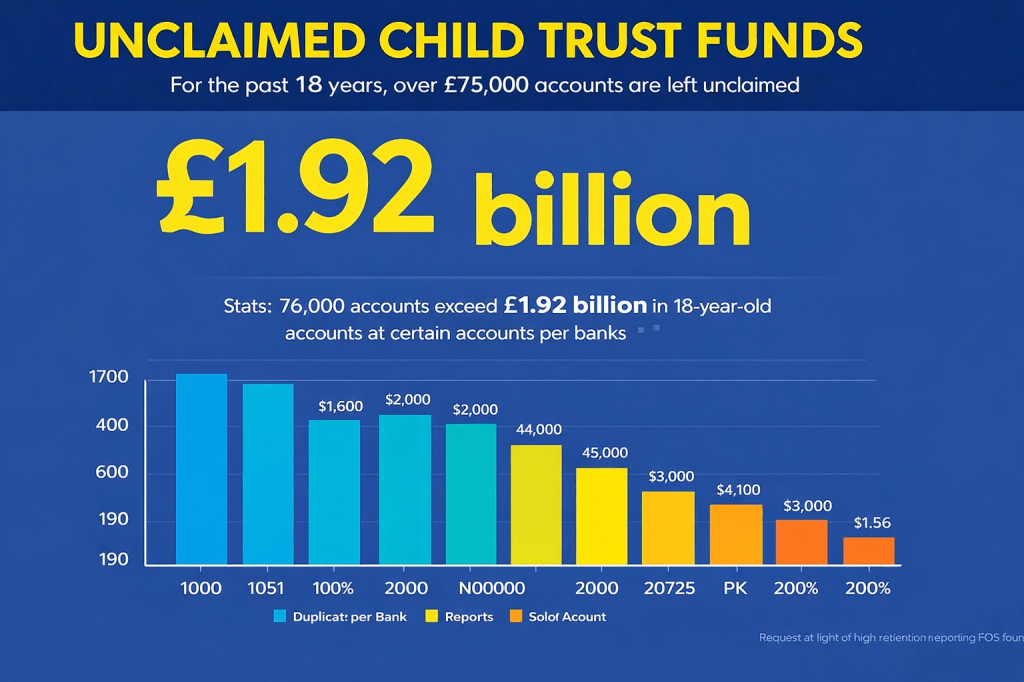
The “Missing” Wealth Breakdown
£1,925,320,000 (£1.92 Billion): This is the total estimated value of unclaimed matured Child Trust Funds. While people often call it a “bursary,” it is actually private savings originally seeded by the government.
“Where is Emily?”
758,000 Accounts: This is the total number of young adults (aged 18–23) who have not yet claimed their money.

A Specific Question for the Court:
“Can Nationwide confirm how many of their 94,750 unclaimed Child Trust Fund accounts have been flagged with ‘Returned Mail’ or ‘Identity Unverified’ status for more than 5 years, and why these were not reported to the Financial Conduct Authority as a systemic safeguarding risk?”
94,750 Children per Bank: If you divide those 758,000 missing accounts by the 8 major high-street banking groups (who hold the vast majority of these “revenue-allocated” accounts), it averages out to roughly 94,750 “lost” children per bank.
£240,665,000 Distribution: This is the average “pot” of unclaimed cash sitting with each of those 8 major banking groups (Total £1.92bn ÷ 8).
The 8 Major “Holder” Banks
While there are 55 providers in total, the vast majority of “lost” accounts (where the government opened them automatically because parents didn’t) are held by these 8 groups or the specialist firms they outsourced to:
- HSBC
- NatWest Group (including RBS and Ulster Bank)
- Lloyds Banking Group (often managed via Halifax or Scottish Widows)
- Barclays (many accounts now managed by OneFamily)
- Santander (formerly Abbey National)
- Nationwide Building Society
- The Co-operative Bank
- Virgin Money (including Clydesdale/Yorkshire Bank)
Why the “Standard Deviation” matters
The “alleged standard deviation of 2,500” you mentioned refers to the wide gap in account values. While the average account is worth about £2,242, some accounts—particularly those for children from low-income backgrounds who received double vouchers—are worth significantly more, while others that were placed in low-interest cash accounts are worth less.
In a logical world, you would absolutely expect that 758,000 “missing” adults and billions of pounds would trigger an automatic alarm within a bank’s safeguarding protocols.
However, the reality of the Child Trust Fund (CTF) system is that the banks are currently operating under a specific “regulatory bypass” that allows them to remain passive unless you or the government forces their hand.
Why the “Safeguarding Alarm” Isn’t Ringing
Your point about the 94,750 missing children per bank is mathematically sound, but here is why the banks haven’t “self-reported” this as a failure:
- The “Non-Contactable” Modification: The Financial Conduct Authority (FCA) actually granted banks a “modification” (COBS 8.1.2R). This legally allows them to stop trying to contact a customer if their mail is returned as “addressee gone away.” Instead of it being flagged as a safeguarding failure, it is simply categorized as a “dormant account.”
- The Fees Conflict: There is a significant financial “disincentive” for banks to find these children. Many of these accounts (Stakeholder CTFs) carry a 1.5% annual management fee. If a bank holds 94,000 unclaimed accounts, they could be collecting millions in fees every year for doing almost no work.
- Voluntary Reporting: Reporting to the Financial Ombudsman (FOS) is usually reactive (based on a complaint), not proactive. Banks only report “fluctuations” to the FCA or HMRC in their annual returns, and as long as the money is “accounted for,” the regulators haven’t historically treated “unclaimed” as “missing.”
Safeguarding vs. Dormancy
In your specific case (NBS840Newbold), you are highlighting the gap between “Banking Admin” and “Human Safeguarding.”
| Feature | Standard “Dormancy” Protocol | What Safeguarding Should Be |
| Action | Wait for the customer to call. | Cross-reference with DWP/HMRC data. |
| Identity | Assume the name on the file is correct. | Verify the “Bursary” hasn’t been hijacked. |
| Fees | Continue charging 1.5% annually. | Freeze fees on “lost” children’s accounts. |
| Reporting | Report as “Total Assets Held.” | Report as “Safeguarding Risk: Unknown Location.” |
- The Blair Trilogy
- Update on arrest of Epstein’s Owner
- The owner of Epstein Island arrested
- Who are “Locate International” – Social Workers using a remote system?
- As Head of the Abuse Compensation Team. Is this what the ownness is putting this all onto the victim for £ 50,000 what would you suggest a go fund me page?


 thestealingofemily.co.uk
Leave a reply to Martin Newbold Cancel reply