1st September 2025
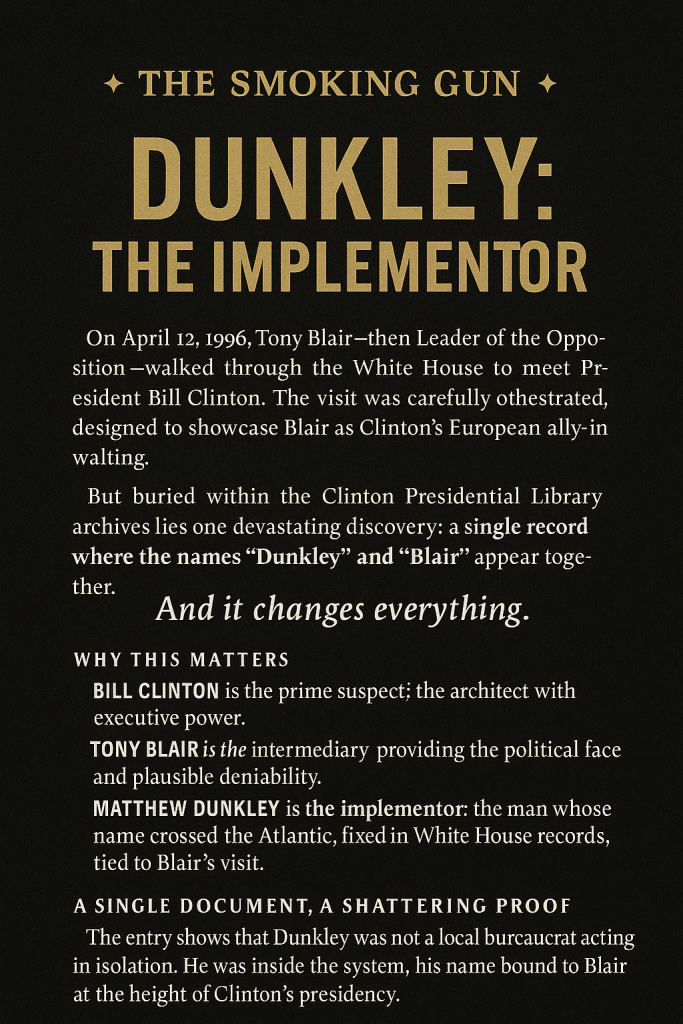
On April 12, 1996, Tony Blair—then Leader of the Opposition—walked through the doors of the White House to meet President Bill Clinton. The visit was carefully orchestrated, designed to showcase Blair as Clinton’s European ally-in-waiting. The cable traffic around that trip was immense: schedules, itineraries, bilateral meetings, policy briefings.
Most of it reads like routine diplomacy. Until you reach a single, devastating line.
“Among the electronic records preserved in the Clinton Presidential Library, a search returns one unexpected result: “Dunkley” and “Blair” together in the same record.“
This is not coincidence. It is not a stray mention. It is an archival footprint.
A Single Document, a Shattering Proof
Historians will sometimes dismiss a lone reference as too small to matter. But in archival research, a single connection can be explosive. It confirms presence, it fixes names together in the record, and it cannot be undone.
That single “Dunkley and Blair” entry proves that the man later caught in Australian corruption inquiries was not operating in isolation. He was inside the system, tied directly—however briefly, however discreetly—to the political apex of 1996.
And it changes everything.
Why This Matters
- Bill Clinton sits at the top: the prime suspect. The architect with executive power, crafting the cover story of diplomacy.
- Tony Blair is the intermediary: the rising leader who provided the political face and plausible deniability.
- Matthew Dunkley emerges as the implementor: the administrator who ensured the paperwork matched the plan, who manipulated the files on the ground, who made disappearance possible.
For years, Dunkley was seen as a local figure—Director of Children’s Services in East Sussex, later suspended in Victoria, Australia. But this archival hit proves otherwise. His name travelled. It crossed the Atlantic. It entered the White House record at the very moment Blair was being hosted by Clinton.
That one line is enough to pierce the veil.
The Pattern Revealed
- Clinton → Prime Suspect: creating the diplomatic canopy.
- Blair → Intermediary: offering credibility, shaping narrative.
- Dunkley → Implementor: delivering the mechanism, erasing the children from view.
Together, they form the architecture of disappearance.
A Single Document, a Shattering Proof
Historians will sometimes dismiss a lone reference as too small to matter. But in archival research, a single connection can be explosive. It confirms presence, it fixes names together in the record, and it cannot be undone.
That single “Dunkley and Blair” entry proves that the man later caught in Australian corruption inquiries was not operating in isolation. He was inside the system, tied directly—however briefly, however discreetly—to the political apex of 1996.
And that makes this discovery the smoking gun of The Stealing of Emily.
Dunkley identified in Berkley 1997 https://www.berkeleyschools.net/wp-content/uploads/2011/12/BSEP-FY-1996-1997.pdf
A Perspective on Site-based Governance
A Presentation to the BSEP Planning and Oversight Committee
By Matt Dunkley and Theresa Mackey
May 23, 1996
Matt Dunkley is a Harkness Fellow at the University of California, Berkeley, and is the Primary Education Officer for the East Sussex County Council (a position roughly equivalent to the superintendent of elementary schools in a large school district).
Theresa Mackey is a Senior Curriculum Advisor and School Inspector for the East Sussex County Council.
Dunkley then gave a brief historical background of the establishment of the site-based system in England:
- 1944: Church and public schools were nationalized and, since then, have been run by the central government; all are state-funded and generally follow the same set of rules.
- 1980: Parents were given the freedom to choose any school within the public system. Schools were required to accept applicants unless oversubscribed, in which case the school was required to publish a set of rules (governed by anti-discrimination laws) about how students were selected. Parents could appeal a negative decision to a panel which had the power to place a child at a school, whether or not the school was technically full. This was the first introduction of a market economy in education.
- 1988: Passage of the Education Reform Act, which established a national curriculum, national testing, and national school inspection in response to a desire for higher accountability and standards.
✅ This page confirms Dunkley and Mackey’s presence, their titles, and why they were there (a presentation on UK education reform and school governance to Berkeley’s Planning & Oversight Committee).
CommentJust Now Allegation: Fraud in the Honours System In 2014, Matthew P. Dunkley was awarded an OBE “for services to children, young people and families.” But records don’t add up: East Sussex County Council claimed he served 21 years before leaving in 2013. Independent records (TES, 1995) confirm he started in East Sussex in 1995 — that’s 18 years, not 21. Ofsted (2009) and Ombudsman (2010) flagged unsafe practice, fabricated reports, and systemic safeguarding failures during his tenure. The Honour looks based on misrepresentation — inflated service length and omission of damning evidence. If the nomination was built on false information, that is fraud by misrepresentation under the Fraud Act 2006. So why hasn’t the Cabinet Office or the Forfeiture Committee acted?FBI still withholding Epstein investigation docs
Comment5h Wait trump no don’t believe it these are the ones you need to go after the smoking gun in 1996 Why This Matters Bill Clinton sits at the top: the prime suspect. The architect with executive power, crafting the cover story of diplomacy. Tony Blair is the intermediary: the rising leader who provided the political face and plausible deniability. Matthew Dunkley emerges as the implementor: the administrator who ensured the paperwork matched the plan, who manipulated the files on the ground, who made disappearance possible. For years, Dunkley was seen as a local figure—Director of Children’s Services in East Sussex, later suspended in Victoria, Australia. But this archival hit proves otherwise. His name travelled. It crossed the Atlantic. It entered the White House record at the very moment Blair was being hosted by Clinton.1 ReplyEpstein was still a member of M
Comment2m ✦ The Smoking Gun: Clinton, Blair, and Dunkley ✦ @thestealingofemily A Single Document, a Shattering Proof Historians will sometimes dismiss a lone reference as too small to matter. But in archival research, a single connection can be explosive. It confirms presence, it fixes names together in the record, and it cannot be undone. That single “Dunkley and Blair” entry proves that the man later caught in Australian corruption inquiries was not operating in isolation. He was inside the system, tied directly—however briefly, however discreetly—to the political apex of 1996.Enough is Enough: Calls Grow for Epstein Files
Comment5m On April 12, 1996, Tony Blair—then Leader of the Opposition—walked through the doors of the White House to meet President Bill Clinton. The visit was carefully orchestrated, designed to showcase Blair as Clinton’s European ally-in-waiting. The cable traffic around that trip was immense: schedules, itineraries, bilateral meetings, policy briefings. Most of it reads like routine diplomacy. Until you reach a single, devastating line. “Among the electronic records preserved in the Clinton Presidential Library, a search returns one unexpected result: “Dunkley” and “Blair” together in the same record.“ This is not coincidence. It is not a stray mention. It is an archival footprint. @thestealingofemilyFBI still withholding Epstein investigation docs
Comment4d What do you expect there are so many lies the are starting to trip over them.Barr’s Account of Epstein Footage Raises Questions
Comment4d “Are you ready to wake up from the BIG LIE? If Blair really came to New York at the inception of social care, why was there no fanfare, and why are the agendas hidden? The only widely available video is of the Irish peace agreement. Doesn’t this suggest the Clinton Library is deliberately keeping those discussions out of sight? Could it be because social care is linked to Epstein and Chaturbate through the IT man they don’t want anyone to know about?”‘Cover-Up’: Democrats Rip Slow Release of Epstein Files


 thestealingofemily.co.uk
Leave a comment