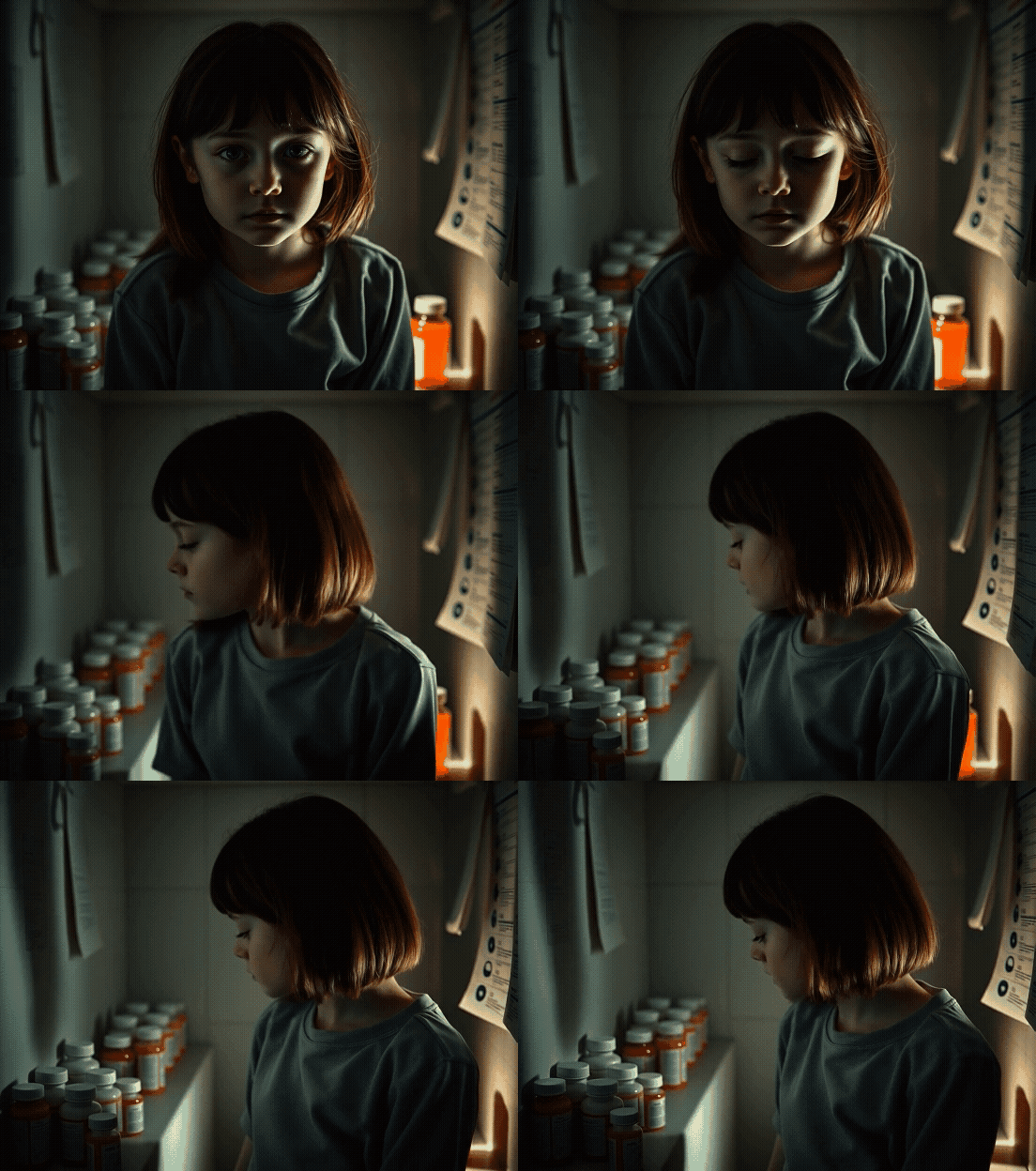
Social Services Failures and the Drug Management of Children in Care
The 2008 report Getting Away With Murder (Scope UK) exposed chilling truths about how institutional indifference, policy failure, and passive public services contributed to the deaths of disabled individuals through hate crime and neglect. Though focused on disabled adults, many of its findings tragically mirror the experiences of children in care, especially those subjected to chemical restraint—a euphemism for the overuse of psychotropic drugs to manage behavior rather than treat illness. A later report was written up by this author at 2025-05-13 – Getting Away With Murder 2025 10.6084m9.figshare.29045015 .pdf
Evidence of Harmful Drug Use on Children in Care
Recent investigations, parliamentary evidence, and professional research confirm that children under the care of the state are frequently prescribed psychotropic medication, not as a therapeutic necessity, but as a tool of control:
- Public Health England (2015) reported that children in care are far more likely to be prescribed antipsychotics and antidepressants, often off-label, and with insufficient psychiatric oversight.
- All-Party Parliamentary Group (APPG) for Looked-After Children raised serious concern in 2017 that social services were defaulting to medication instead of trauma-informed care. It noted that many children were medicated without access to talking therapies or proper psychiatric assessment.
- Care Quality Commission and Ofsted joint reviews documented inconsistent governance of medication in children’s homes and lack of consent protocols, particularly in residential and secure placements.
- Academic researchers such as Dr. Sami Timimi have argued that the medicalisation of childhood distress—especially for looked-after children—is a direct result of a risk-averse, underfunded system that sees control as easier than compassion.
- Serious Case Reviews (SCRs), including cases involving the deaths of children, have found long-term psychotropic drug use without adequate review, and in some cases no clear diagnosis or ongoing psychiatric input.
Systemic Neglect and Breach of Duty
The use of psychotropic drugs in this context amounts to chemical restraint and, in many cases, state-sanctioned neglect. When combined with lack of family advocacy, minimal oversight, and no clear channels for whistleblowing, it creates an environment in which:
- Vulnerable children are silenced.
- Behaviour is pathologised rather than understood.
- Oversight bodies and local authorities escape accountability.
As Getting Away With Murder rightly warned: “What happens to vulnerable people who are not valued by the system is that their deaths go uninvestigated and their lives unmourned by the state.”
This can now be said of children in the care of the state, many of whom are:
- Moved between placements.
- Denied stable relationships.
- Managed through medication rather than healing.
- Placed in environments that rely on coercion rather than care.
Call for Accountability
This is not merely a safeguarding issue—it is a civil and human rights violation. The use of chemical restraint:
- Breaches Article 3 of the European Convention on Human Rights (freedom from inhuman or degrading treatment).
- Violates the Children Act 1989 duty to promote the welfare of looked-after children.
- Contravenes the UN Convention on the Rights of the Child, especially the right to health and protection from abuse.
Conclusion
It is time to reframe these cases not as isolated tragedies or individual errors, but as the result of systemic social services failure. As Getting Away With Murder warns, when institutions see vulnerable children as problems to be managed, rather than people to be supported, it is no surprise that these practices lead to lifelong harm—or death.
1. Scope – Getting Away With Murder (2008)
A landmark report documenting the systemic neglect and indifference towards disabled people, leading to preventable deaths.
- Citation: Scope UK. (2008). Getting Away With Murder: Disabled people’s experiences of hate crime in the UK.
- URL: https://bristolsafeguarding.org/media/1328/getting-away-with-murder.pdf
2. Public Health England – Prescribing of Psychotropic Drugs to Children and Young People (2016)
Found children in care are disproportionately prescribed psychotropic drugs, often off-label and without sufficient oversight.
- Citation: Public Health England. (2016). Prescribing of psychotropic drugs to children and young people looked after by local authorities.
- URL: https://www.gov.uk/government/publications/prescribing-of-psychotropic-drugs-to-children-looked-after-by-local-authorities
3. APPG for Looked-After Children – Inquiry into Mental Health (2016–2017)
Parliamentary evidence highlighting inappropriate medication as a substitute for mental health support in care.
- Citation: APPG for Looked After Children. (2017). Access to Mental Health Services for Children in Care.
- URL: https://www.childrenssociety.org.uk/sites/default/files/2020-10/appg-inquiry-into-mental-health-access.pdf
4. Ofsted & CQC – Mental Health Services Review (2018)
Joint review shows widespread inconsistency and risk in managing mental health and medication in residential care.
- Citation: CQC & Ofsted. (2018). Are we listening? A review of children and young people’s mental health services.
- URL: https://www.cqc.org.uk/publications/themed-work/are-we-listening-review-children-young-peoples-mental-health-services
5. Dr. Sami Timimi – Psychiatry and Childhood
Academic work highlighting the dangers of over-medicalising childhood and the misuse of ADHD and psychiatric labels.
- Citation: Timimi, S. (2011). The Myth of Autism: Medicalising Men’s and Boys’ Social and Emotional Competence.
- Further Info: https://www.crcambridge.org/blog/sami-timimi-critic-of-child-psychiatry
6. UN Committee on the Rights of the Child – Concluding Observations on UK (2016)
Raised concern about the use of psychotropic drugs on children in state care.
- Citation: United Nations. (2016). Concluding observations on the fifth periodic report of the United Kingdom of Great Britain and Northern Ireland.
- URL: https://tbinternet.ohchr.org/_layouts/15/treatybodyexternal/Download.aspx?symbolno=CRC/C/GBR/CO/5&Lang=En
7. NSPCC Learning – Looked-after Children
Analysis of mental health and safeguarding risks, including inappropriate responses to trauma.
- Citation: NSPCC Learning. (2022). Looked-after children: Learning from case reviews.
- URL: https://learning.nspcc.org.uk/research-resources/learning-from-case-reviews/looked-after-children


 thestealingofemily.co.uk
Leave a comment