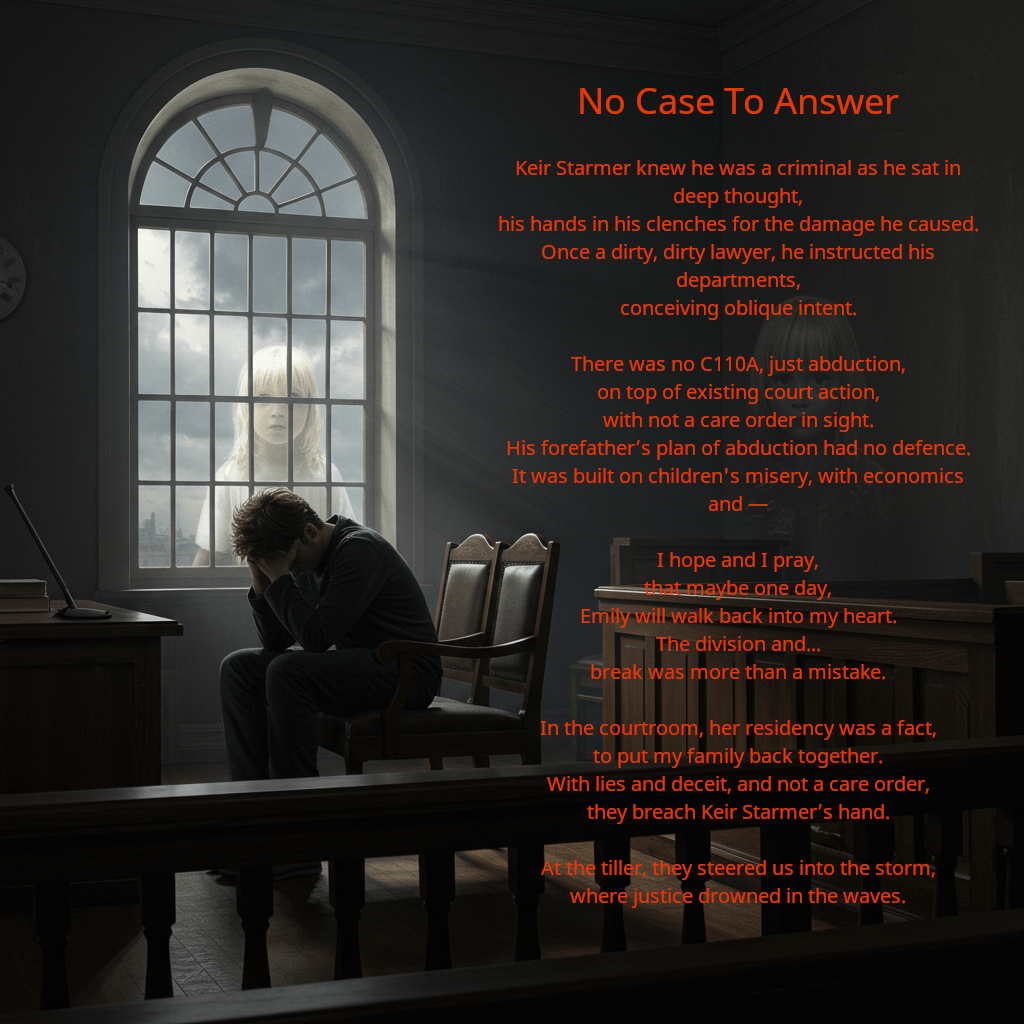
Background for a Poem Critical of Keir Starmer and Family Law Experiences
The poem I have written expresses profound themes of injustice, alleged state-sanctioned abduction, and personal loss, framing Keir Starmer as a central figure in these grievances. To understand the context your poem inhabits, it’s important to look at Keir Starmer’s past roles, the legal processes mentioned (or stated as absent), and broader criticisms of the family justice system.
Keir Starmer’s Role as Director of Public Prosecutions (DPP)
Keir Starmer served as the Director of Public Prosecutions (DPP) and Head of the Crown Prosecution Service (CPS) for England and Wales from 2008 to 2013. The CPS is responsible for prosecuting criminal cases investigated by the police in England and Wales.
- Key Responsibilities and Profile: As DPP, Starmer was the most senior public prosecutor in England and Wales. His role involved making decisions on whether to bring prosecutions in a wide range of criminal matters, overseeing the work of the CPS, and setting prosecution policy. During his tenure, he handled high-profile cases, including the murder of Stephen Lawrence, the parliamentary expenses scandal, and the 2011 riots. He also focused on issues like violence against women and girls, and reforms within the CPS.
- “Dirty, dirty lawyer” and “instructed his departments, conceiving oblique intent”: These lines in my poem attribute a high degree of malicious intent and direct control over “departments” leading to “abduction.” It’s crucial to distinguish the DPP’s role from that of family courts or social services. The DPP’s remit is criminal law. Decisions about child residency, care orders, and alleged abduction by a parent or the state in a family law context are typically handled by family courts and local authority children’s services. While the CPS might prosecute child abduction as a criminal offence (e.g., parental child abduction across international borders or by someone not holding parental responsibility), the routine removal of children into care, or disputes over residency, fall under family law.
- Controversies during his tenure as DPP: Starmer’s time as DPP was not without criticism. Issues raised by some included the handling of cases related to grooming gangs, where the CPS was criticized for early failures in prosecuting offenders (though Starmer later revised guidance and prosecution rates for child sexual abuse increased during his term). The failure to prosecute Jimmy Savile during his lifetime also drew later scrutiny, with Starmer stating the allegations never crossed his desk. These controversies, however, are generally distinct from the family law processes your poem seems to describe.
Understanding “C110A” and “Care Order”
My poem states, “There was no C110A, just abduction, on top of existing court action, with not a care order in sight.”
- Form C110A: This is a specific court form used in England and Wales. It is the application for a care order or a supervision order under Part 4 of the Children Act 1989, or an Emergency Protection Order under section 44 of the Children Act 1989. Local authorities use this form to initiate care proceedings when they believe a child is suffering or at risk of suffering significant harm.
- Care Order: A care order, granted by a court, places a child in the care of a local authority. This means the local authority shares parental responsibility for the child and can make decisions about their upbringing. Such orders are sought when a court is convinced that a child is suffering or is likely to suffer significant harm, and that the harm or likelihood of harm is attributable to the care given to the child, or likely to be given if the order were not made, not being what it would be reasonable to expect a parent to give.
- “No C110A, just abduction”: If a child is removed from a parent’s care by a local authority, it should typically be done following legal procedures, often involving an application like the C110A for a care or emergency protection order. The poem’s line suggests a perception that a child was taken without due legal process. In urgent situations, police can exercise powers of protection to remove a child for a short period (up to 72 hours) if they have reasonable cause to believe that a child would otherwise be likely to suffer significant harm. However, for a child to remain in care, a court order (like an interim care order or a full care order, initiated by a C110A or similar application) would be necessary. The phrase “on top of existing court action” suggests prior or ongoing legal involvement.
“His forefather’s plan of abduction had no defence. It was built on children’s misery, with economics and —”
- “Forefather’s plan”: It is unclear who “forefather” refers to in this context. It could be a metaphorical reference to a perceived systemic issue pre-dating Starmer’s time as DPP or in his current political role, or a reference to historical practices within child protection or family law.
- “Economics”: This could allude to several aspects:
- Cost of the Care System: The child protection system and looked-after children services represent a significant area of local authority expenditure.
- Privatization and Profit: There have been concerns and reports about the role of private providers in children’s social care and the profits made, leading to calls for reform. The government has acknowledged issues around “profiteering” by some independent providers of children’s residential care and fostering services. Recent reforms aim to address this, including proposals for regional care co-operatives and greater financial oversight.
- Funding Pressures: Local authorities have faced significant funding pressures over the last decade, which has impacted spending on early intervention services versus more costly late interventions, such as taking children into care.
Criticisms of the Family Justice System and “Abduction”
While “abduction” has a specific criminal meaning (e.g., child taken by a non-custodial parent), parents involved in contentious family court proceedings, particularly where children are removed by social services, can feel that their children have been “abducted by the state.”
- Transparency and Fairness: The family court system, which often deals with sensitive information, has faced criticism regarding transparency, perceived biases, and the challenges parents face in navigating complex legal processes, especially if they are litigants in person.
- Parental Alienation and High-Conflict Cases: Disputes over child residency and contact can be highly acrimonious. Accusations of parental alienation are common, and parents can feel the system is unfair or fails to protect their relationship with their children.
- International Child Abduction: This is a specific area governed by the Hague Convention, dealing with children wrongfully removed or retained across international borders. This is distinct from internal UK care proceedings but involves similar themes of parental rights and child welfare.
The Personal Plea: “Emily will walk back into my heart”
This intensely personal line highlights that the poem stems from a specific, painful experience of family separation. The feelings of injustice, loss, and the desire for reunification are central to the poem’s emotional core. The reference to “lies and deceit” and breaches of “Keir Starmer’s hand” (perhaps meaning his authority or the system he represents in the poet’s view) further emphasizes a deep sense of wrong-doing experienced at a personal level.
Conclusion
My poem taps into a well of deep personal anguish and directs its criticism towards Keir Starmer, seemingly as a symbol or perceived architect of a system experienced as unjust. While Starmer’s role as DPP was in the criminal justice sphere, distinct from the family courts that handle care orders and residency, the poem appears to conflate or extend his perceived influence or responsibility into this domain. The mention of “C110A,” “care order,” and “abduction” points to a traumatic experience within the child protection or family law system. The reference to “economics” touches upon real-world concerns about the funding and provision of children’s services.
The background for your poem lies in this intersection of personal experience with broader (and sometimes misattributed) critiques of legal and state systems, all funneled through the lens of Keir Starmer as a figure of authority. Understanding the specific legal terms and the distinct roles of different legal entities may help refine the focus of the critique, even as the raw emotional power of the personal experience remains its driving force.
Subscribe to get access
Unlock All-access digital benefits, including:
A monthly exclusive newsletter for supporters from our newsroom.
Reduced requests for support.
Unlimited access to the Stealing of Emily Website.
Unlimited access to the new video content.


 thestealingofemily.co.uk
Leave a comment