
FSX Help Center
Subject: Formal Complaint Regarding Case Impact – Ref: 269935
by email only
11th February 2025
Dear Sir/Madam,
I am writing to formally raise concerns regarding the ongoing consequences of the Delaware Court’s decision in Twitter, Inc. v. Elon R. Musk, X Holdings I, Inc., and X Holdings II, Inc. (Case No.: 2022-0613-KSJM). The outcome of this case has directly contributed to the current situation, particularly regarding the appointment of key individuals within XCorp.
As I have previously stated, you have provided no means of electronic filing.
As a result, I have been forced to incur the cost of sending this correspondence via Royal Mail Tracked Delivery (RN844103513GB) to the USA, as XCorp and X offer no accessible technical support personnel.
Following these proceedings, I have experienced significant difficulties obtaining technical support and assistance. XCorp now lacks adequate support infrastructure, offering only automated email responses that fail to provide meaningful resolutions or reciprocal communication. This lack of accountability has left my issue (Ref: 269935) unresolved, which is wholly unacceptable. Additionally, the suppression of free speech has compounded these concerns, limiting my ability to seek redress or openly discuss these matters.
Even XCorp’s own public position on free speech appears inconsistent. Their official blog post, “Stand with X to Protect Free Speech,” (link) focuses primarily on hate speech rather than the broader principle of free expression. This raises serious concerns about the company’s true commitment to open discourse.
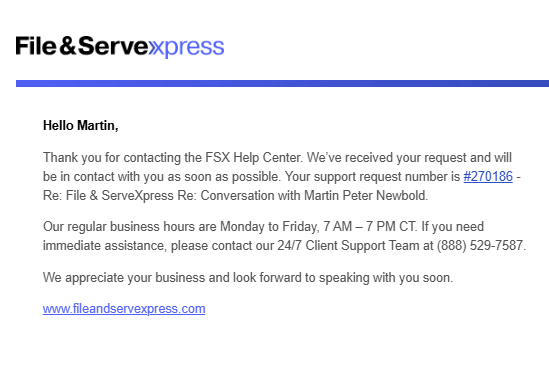
I request that this matter be reviewed urgently and that appropriate action be taken to ensure that affected individuals receive the necessary support. Furthermore, I seek clarification on how the Delaware Court intends to address the ongoing consequences of its ruling—particularly in cases where individuals are left without proper recourse and are unable to exercise their right to free speech.
Please confirm receipt of this correspondence and advise on the next steps. I appreciate your urgent attention to this matter.
Sincerely,
Mr. Martin Newbold
“Twiddley Dee Twiddley Dum, look out, baby, here I come!”
Crowdfunding to support social welfare on JustGiving
The Inside Information.
This has raised concerns regarding potential violations of the First Amendment by Elon Musk, who, according to recent reports, has been sworn in as a special government employee under the Department of Government Efficiency (DOGE). This development, as outlined in this report,(https://www.msn.com/en-us/news/world/do-elon-musk-and-doge-have-power-to-close-us-government-agencies) suggests that Musk now holds an official government role, which legally subjects him to constitutional limitations—including those imposed by the First Amendment.
“Magic Blue Pony” algorithm, developed by MAGIC PONY TECHNOLOGY LIMITED, which I have already advised you of its existence under company number 09356191, is designed for image recognition and content analysis. It’s clear that you’ve identified a potential limitation where this algorithm struggles with accessing images hosted outside of their platform due to modern web security protocols and changes in how cross-site resources are handled. Put plainly the worldwide web changed without most of us knowing. Chruch Base decribes this “Magic Pony Technology is a technology company that develops machine-learning based approach for visual processing on web and mobile.“
- Early Implementation of the Same-Origin Policy (SOP) (1995–2000s)
SOP prevents a script on one domain from accessing resources (such as cookies, DOM elements, or files) on another domain.
This stopped direct JavaScript access to files from other sites. - Cross-Origin Resource Sharing (CORS) (2009)
W3C introduced CORS to allow controlled cross-origin access by requiring explicit permission from the target server.
Without the correct Access-Control-Allow-Origin headers, browsers block cross-origin requests. - Blocking Cross-Origin File Access (2010s)
XHR & Fetch API Restrictions: Browsers began blocking cross-origin file requests unless explicitly allowed.
File URI Restrictions: Accessing local files (file://) from a remote webpage was blocked for security reasons.
Cross-Origin Read Blocking (CORB) (2018): Google Chrome implemented CORB to block sensitive data in cross-origin responses that lack proper CORS headers. - More Stringent Fetch Metadata (2020s)
Browsers introduced Fetch Metadata Request Headers (Sec-Fetch-Site, Sec-Fetch-Mode) to detect and block unauthorized cross-origin resource access.
Websites can now configure Cross-Origin-Opener-Policy (COOP) and Cross-Origin-Embedder-Policy (COEP) to fully isolate their context. - Deprecation of Insecure Protocols & Third-Party Access
Blocking Mixed Content (2019–2023): Browsers started blocking HTTP resources from loading on HTTPS pages.
Third-Party Cookie Phase-Out (2024): Google Chrome and other browsers have begun restricting cookies and storage access across sites.
Current Situation
As of 2024–2025, websites cannot open or access files on other websites unless:
- The target site explicitly allows access via CORS.
- The requesting site has the appropriate credentials and authentication tokens.
- The target file is publicly accessible and not protected by security headers like COEP or CORB.
Subscribe to get access
Unlock All-access digital benefits, including:
A monthly exclusive newsletter for supporters from our newsroom.
Reduced requests for support.
Unlimited access to the Stealing of Emily Website.
Unlimited access to the new video content.


 thestealingofemily.co.uk
Leave a comment