
Image Credit : Credit:Nenov, iStock
NEWS | AUSTRALIA |AUSTRALIA NEWS | LOCAL NEWS.
THE UNTOLD STORY OF BABY TRAFFICKING IN VICTORIA AUSTRALIA. – IDENTITY (wordpress.com) Posted on March 30, 2019 And more information available in The Stealing OF Emilly Trilogy.
“Parliament must act to sort out the child protection system.”
It comes to mind a certain children’s director who was allegedly deported from Australia after an investigation into the Education System das denoted in the Stealing of Emily trilogy of books. There seems then to be a link between Australia east Sussex, Kent Norfolk where this individual worked in a management directors’ position.
Tony Blair’s impact on social work and adoption policies during his tenure as Prime Minister of the United Kingdom brought about sweeping changes that reverberated through the system. One of the pivotal moments during Blair’s time in office was the Meadows debacle, which prompted significant shifts in the way social workers operated. In an article written by Dunkley in 1996 for the online TES magazine entitled ‘Making Connections,’ there is a mention of his travels to America, where he engaged with symposiums and conference attendees. It is conjectured that during these travels, Dunkley may have crossed paths with Bill Clinton, the President of the United States at the time, and perhaps even captured his attention with his work.
Speculating based on Dunkley’s birth year of 1961 and the 21 years he was known to have worked in East Sussex, it is reasonable to infer that Dunkley likely commenced his role in East Sussex around 1996-1997. This timeframe potentially places Dunkley in the right place at the right time when Tony Blair sought to fortify his ranks in the UK to address the growing disconnect between children and their biological parents.
In 2005, Prime Minister Tony Blair unveiled a new initiative aimed at expediting the process of placing children into the care system. In his foreword on the White Paper titled “Adoption – A New Approach,” he emphasized the shared responsibility of ensuring a fresh start and loving family environment for children unable to reside with their birth parents. This initiative marked the establishment of a fundamental review of adoption policies and practices, introducing a regime that facilitated the removal of children and the creation of a ‘supply side’ to acquire children from what were considered ‘acceptable mothers.’
This approach, likened to a ‘conveyor belt’ system, allowed for the swift removal of children from their families and their subsequent placement for adoption, sometimes even in foreign countries separated by sea borders. The intricacies of these processes were shrouded in secrecy, potentially giving rise to insinuations of impropriety or being encumbered by bureaucracy.
Dunkley suspended as corruption probe continues
The embattled education director had been sacked and dismissed from his position as South Western Regional Director, with anti-corruption investigations into the Victorian government department. The Education and Training’s regional director for the south west was suspended from his role on Tuesday 15th March 2016 when an independent inquiry heard that he knew former education department executive John Allman had “destroyed” evidence. Mr. Allman confirmed he dumped financial documents in a bin at a Bunnings Warehouse after IBAC investigators had been to his home. In phone-tapped conversations between Mr. Dunkley and Mr. Allman dated October 2014, Dunkley was also immediately removed from the education department’s integrity committee, to which he had been appointed in the wake of IBAC’s investigations. It was reported again in the Geelong Advertiser in a news story they broke that IBAC Ultranet report former-boss Matthew Dunkley was not yet fully cleared by the anti-corruption body. The Independent Broad-based Anti-Corruption Commission released a scathing report on Friday into the Department of Education’s bungled Ultranet project, revealing a disturbing pattern of improper behavior in Ultranet. This revelation has sparked further attention on the various aspects of the case, with the ongoing probe drawing significant public interest and scrutiny. The impact of these findings is expected to have far-reaching implications across the education sector and underscore the importance of maintaining integrity and transparency within government institutions.
The information you provided is related to a statement made by the Independent Broad-based Commission Against Corruption (IBAC) on May 21, 2018, regarding the laying of charges following an extensive investigation named Operation Dunham. This is a significant development that emerged from the commission’s efforts to address corruption. Additionally, on January 11, 2017, a report surfaced indicating a recording where Mr. Dunkley was heard telling a former education department executive about having previously confessed to “destroying” evidence. These events shed light on the actions and statements of individuals involved in the education sector, raising concerns about integrity and accountability. The public disclosure of such details is essential for maintaining transparency and ensuring that appropriate measures are taken to uphold ethical standards within educational institutions and beyond.
It is apparent Dunkley left before this enquiry as it is alleged his visa expired, which was a four-month visa. The 482 is a temporary visa, which entitles skilled workers to work in Australia for up to four years if they are sponsored by an approved Australian employer, as he is a possibly suspicious person to the Australian Government.
The issue of visa expiration and compliance is of utmost importance, especially in the context of international employment. Dunkley’s departure prior to the inquiry raises questions regarding the status of his visa, particularly given the nature of the 482 visa as a temporary document that allows skilled workers to contribute to the Australian workforce. It’s essential for all individuals under such visas to adhere to the associated regulations and guidelines. The implications of any perceived violation in this regard can be significant, warranting thorough investigation and potential legal ramifications.
The Australian Government’s scrutiny of individuals holding temporary visas is a fundamental aspect of maintaining national security and lawful immigration practices. Any suspicion in this context necessitates appropriate authorities to conduct a comprehensive assessment to ensure the integrity of the immigration system and the safety of the country as a whole. As such, the circumstances surrounding Dunkley’s departure and the expiry of his visa demand careful examination to determine any potential irregularities or concerns that may need to be addressed through official channels.
[1] https://www.edp24.co.uk/news/local-council/20853170.new-interim-director-norfolk-county-councils-childrens-services-exonerated-suspension-previous-job/ https://www.geelongadvertiser.com.au/news/geelong/department-of-education-and-training-southwest-regional-director-matthew-dunkley-suspended-as-corruption-probe-continues/news-story/f2ba93b24fb6ec0bcc3c99a135dd59a2
[2] https://www.abc.net.au/news/2017-01-27/millions-wasted-in-failed-ultranet-online-portal-ibac-says/8217072
[3] https://www.geelongadvertiser.com.au/news/geelong/department-of-education-and-training-southwest-regional-director-matthew-dunkley-suspended-as-corruption-probe-continues/news-story/f2ba93b24fb6ec0bcc3c99a135dd59a2
The issue of vulnerable infants being sold to couples for a mere 50 pounds is a troubling and deeply distressing aspect of Australia’s social and political history. The fact that these children’s stories remain largely hidden further underscores the need for acknowledgment and redress by the Australian Government. The historical backdrop of male dominance and covert graft, linked to the abortion racket, sheds light on the systemic issues that allowed such exploitation to occur. The documentation of these appalling events in daily newspaper articles, women’s magazines, and even parliamentary debates amplifies the urgent need for recognition and justice. It is crucial that these injustices are brought to light and addressed in order to honor the lives of those affected and to prevent such egregious violations from occurring in the future.
The specific relevant content for this request, if necessary, delimited with characters: Australian Governments have yet to acknowledge the plight of many of vulnerable infants who were sold to couples for 50 pounds.
These children’s stories remain a hidden part of our social and political history.
With a history of Male dominance and being shielded in covert graft which was linked to the abortion racquet the sale of babies was recorded in daily newspaper articles, women’s magazines, and even in parliamentary debates.
The introduction of the Model Adoption Of Children’s act in 1964 marked a significant shift in the landscape of adoption in Australia. The inauguration of a Principle Officer theoretically eliminated the need for a Father’s consent, altering the traditional dynamics of adoption. However, this legislative change also brought about the cessation of the understood meaning of private adoptions, placing the process of adoption predominantly in the hands of church-based Non-Government Organizations (NGOs). This shift had far-reaching implications, shaping the experiences of countless individuals involved in the adoption process during that era.
The babies born prior to the proclamation of the 1964 Adoption Of Children act, which is the primary focus of this discussion, are now adults aged 50 years and above. For some of these individuals, the search for information about their birth circumstances continues, while for others, this exploration may not have even begun. This is a period marked by the complexities and challenges of baby trafficking, with many adults still seeking to uncover their true origins and navigate the implications of the historical adoption practices.
Following the aftermath of the 2nd World War, the establishment of sterility clinics in major hospitals across Australia emerged as a direct response to the significant number of servicemen who were unable to start families. Adoption was viewed as the new panacea in this post-war landscape, reflecting the societal shifts and challenges that shaped the context for adoption during this time in Australian history.

1. The demand to adopt increased amid the general populace, particularly female babies under twelve months
2. Adoption was embraced and transformed by the wider community to create a perfect solution for adopters and mothers with babies born out of wedlock. Appalled with the introduction of a Commonwealth pension by the Prime minister Mr Menzies for unmarried women of military personal the moral high ground was being heavily enforced by the churches.
3 An unfortunate mother could place her baby for adoption and then return to her rightful place in society, and a child would not have to wear the blight, because it would have two married parents, and it solved the problem of infertility or of a person with a history of still born baby’s. Adoption was also seen by some doctors to be a profitable opportunity and they placed it as an adjunct to their lucrative abortion racquet
4 An article published in a Sydney newspaper in 1950 claiming a ring was employing operators in Victoria to run a black market in illegitimate babies and charging mothers to have their babies at a private premise, they guaranteed, that they would find a good home for their baby. The baby was then sold by the operator to the highest bidder. In 1950, another claim was made that an interstate organization with contracts in the majority of hospitals and foundling homes was responsible for the trade of babies throughout the Commonwealth.
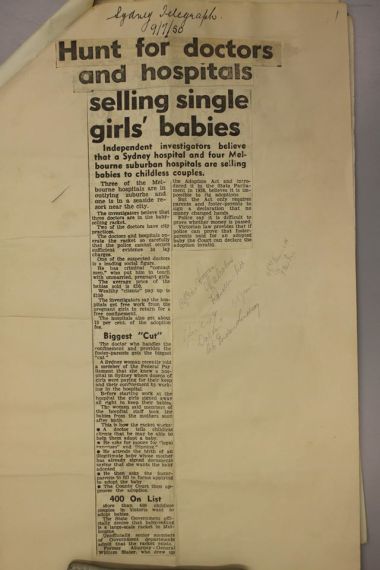
The organization’s headquarters was believed to be located in Sydney, and it was rumored that through the right channels in Melbourne, it was possible to buy a baby. In a shocking display of their determination to expose these unscrupulous individuals, two investigative journalists went to a hotel and purchased a baby for 25 pounds. The distressing reality was that in most cases, the women involved did not receive any compensation for their babies. Instead, it was reported that the “baby black marketers” kept all the money made from the sale. This dark and exploitative practice sheds light on the depths of human depravity and the urgent need for robust measures to protect vulnerable mothers and their children from such exploitation.
6. The headlines of the Argus read “Baby Traffic Probe is on” when reporting an investigation was being held into babies being sold to childless couples. The article reported that Mr Cremean from the Federal Labour Government revealed in The House of Representatives parliament that the practice for charging for the adoption was a widespread practice in capital cities
The headline “Baby Traffic Probe is on” in The Argus highlighted the initiation of an investigation into the disturbing issue of babies being sold to childless couples. This revelation led to significant public concern and raised important questions about the welfare and security of these vulnerable infants. In a notable disclosure, Mr Cremean of the Federal Labour Government addressed the Parliament of the House of Representatives, shedding light on the widespread practice of charging for adoptions in capital cities. This revelation underscores the urgent need for comprehensive measures to address and prevent such exploitative practices, emphasizing the critical importance of safeguarding the well-being of children and ensuring ethical adoption processes.
7. it is alleged Mr. E.J. Pittard, Secretary of the Victorian Children’s Welfare department, vehemently denied the claims. He affirmed that the adoption of Infants act explicitly stated that payments to the “child’s parents” for possession of the child were illegal. He argued that adoptions had to be authorized by a County Court judge, and further emphasized that a judge would refuse to authorize the adoption. On the other hand, unofficially, senior members of government departments have admitted to the existence of the racket. However, police say that it is exceedingly difficult to prove whether money is illicitly passing hands in these transactions. The intricacies of these claims have sparked heated debates among legal experts, child welfare advocates, and law enforcement authorities, raising significant concerns about the protection and well-being of vulnerable children within the adoption system. This controversial issue continues to draw widespread attention and scrutiny as various stakeholders strive to address the complexities surrounding the process of adoption and the protection of children’s rights.
8. In the 1950’s, Mrs Primrose, Secretary of an East Melbourne Founding’s home highlighted that they had a long list of people wanting to adopt children.
Victorian Police admitted that the “law controlling babies was loose and could be exploited, but there was no evidence to support the charge made by Mr Cremean that babies were being sold for 50 pounds”
20 The Victorian police claimed to have had no knowledge of a black market in babies

9. One month later in April 1950, a newspaper reported that one Melbourne hospital and one doctor were believed to be involved in a baby selling racket in Melbourne the article does not identify the name of the hospital or doctor.
For more information check the link on the top of the page which has all the information on it some which has been deleted which included a video that is no longer available.
In conclusion, the narrative surrounding the alleged baby trafficking in Victoria, Australia, and the subsequent investigation into the education system paints a complex picture of systemic issues and individual accountability. The involvement of figures such as Tony Blair and the speculated connections with international policies highlight the far-reaching implications of adoption and social work reforms. The case of the suspended education director, entangled in corruption probes and the Ultranet scandal, underscores the challenges of maintaining integrity within governmental departments. As the story unfolds, it becomes evident that the quest for transparency and justice is not only a local concern but a global one, affecting the lives of the most vulnerable—children separated from their biological families. The Stealing of Emily trilogy, while a work of fiction, serves as a poignant reminder of the real-world consequences of policy decisions and the importance of safeguarding the rights and well-being of children worldwide.
Enter your email below to receive updates.


 thestealingofemily.co.uk
Leave a comment